
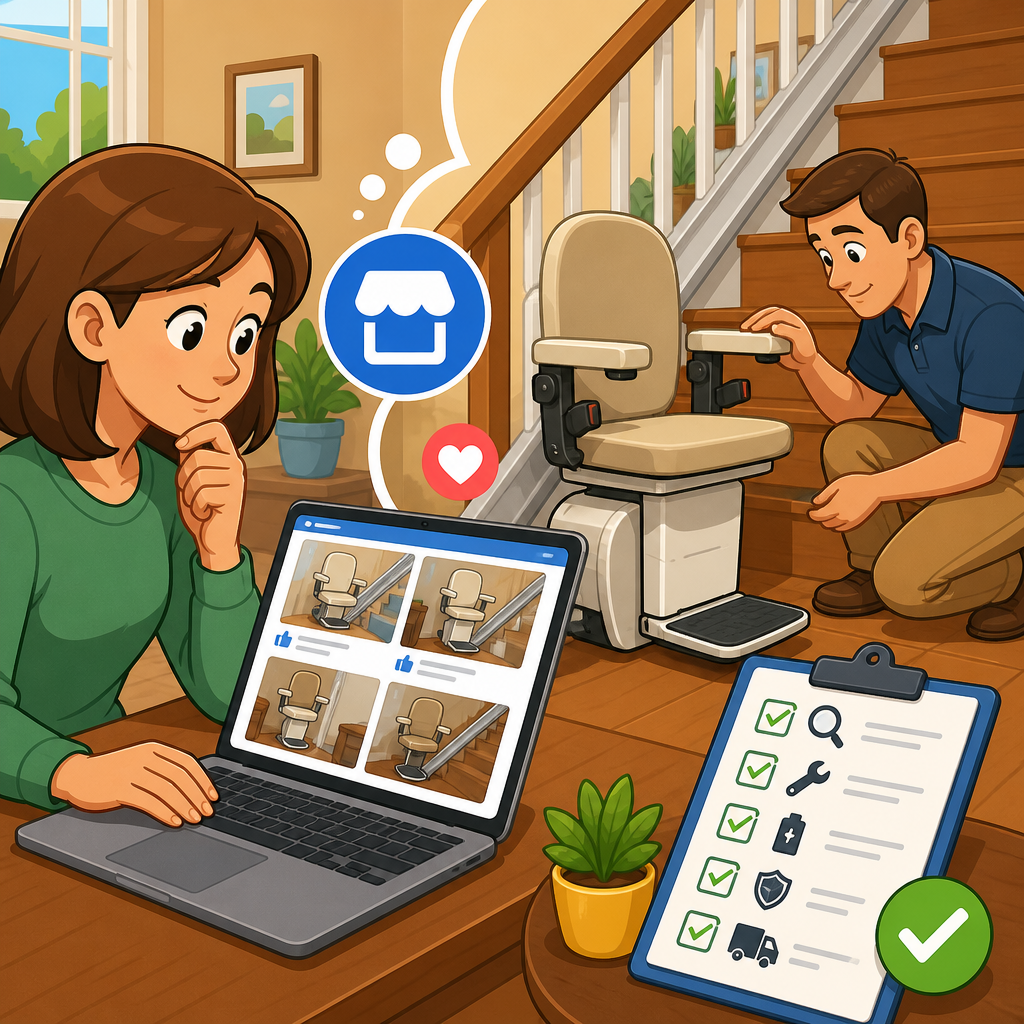
Buying a used stair lift on Facebook Marketplace can look like an easy way to save thousands of dollars, but the lower sticker price often hides installation problems, safety gaps, and ownership questions that buyers do not discover until the unit is already in their home. A stair lift is a motorized chair that travels on a rail attached to stair treads, helping people with limited mobility move safely between floors. In the used market, you will also see the terms chair lift, stair chair, refurbished stair lift, and reconditioned stair lift. They are related, but not identical. A used stair lift is typically sold as-is by a previous owner. A refurbished stair lift has usually been inspected, repaired, cleaned, and tested by a dealer or manufacturer. That distinction matters because a stair lift is not like buying secondhand furniture. It is a piece of accessibility equipment that must fit a specific staircase, support a rated user weight, stop accurately at charging points, and comply with installation and battery requirements.
I have worked with families comparing dealer-refurbished units against peer-to-peer listings, and the same pattern appears repeatedly: buyers focus on the posted Marketplace price and underestimate removal, transport, missing parts, rail incompatibility, and the cost of finding a qualified installer willing to touch someone else’s equipment. In many cases, the advertised bargain disappears once you add a site assessment, replacement batteries, service labor, and a new rail section. Facebook Marketplace especially amplifies this risk because listings are brief, technical details are often wrong, and sellers may not know the exact brand, model, rail type, age, or service history. Still, not every listing is a bad idea. If you know how to evaluate the lift, verify fit, and calculate full ownership cost, a used or refurbished chair lift can be a practical option for temporary recovery, rental alternatives, or budget-constrained households.
This guide is the hub for used and refurbished chair lifts within a broader buying-guides framework. It explains the real risks, what questions to ask, which brands tend to have better parts support, why curved lifts are usually poor Marketplace purchases, and how to use a checklist before money changes hands. If you are trying to decide whether to buy a used stair lift from Facebook Marketplace, the short answer is this: straight stair lifts can sometimes be worth considering if the model is recent, the rail length matches your staircase, the seller can document ownership and operation, and a local dealer confirms service availability. Curved stair lifts, very old units, and listings with missing photos or vague descriptions should generally be avoided.
Why Facebook Marketplace listings are risky for used stair lifts
The biggest risk is mismatch. Most stair lifts are staircase-specific systems, not universal appliances. A straight stair lift runs on a straight rail and has some flexibility if the rail can be cut or extended within manufacturer limits. A curved stair lift is usually custom-built to the exact dimensions, turns, and landings of one staircase. In practice, that means a curved lift removed from another home almost never fits yours without major reengineering, and many manufacturers will not modify old curved rails at all. Buyers often discover this after purchase because a seller simply writes “works great” without understanding that functionality in one home says nothing about compatibility in another.
The second risk is unknown service history. A stair lift relies on batteries, a charger, a motor, a gearbox, limit switches, seat swivels, safety edges, call-send controls, and rail contacts. Any one of these can fail with age, storage conditions, or improper removal. Lead-acid batteries, common in many units, may need replacement every few years even when the lift is lightly used. If a lift has been sitting in a garage for months without proper charging, battery performance may be severely reduced. I have seen Marketplace lifts listed as “just needs batteries,” only for buyers to learn later that the charger board, carriage wiring, or arm switch was also defective.
There is also a liability and support issue. Many local stair lift dealers make their margin on installation, warranty coverage, and ongoing service. Some will not install a lift purchased privately because they cannot verify the condition, they may inherit safety risk, and they would be responsible for making an incomplete system operable. Even if they agree, labor rates are often higher for customer-supplied equipment. That service barrier is one of the least understood costs in the secondhand market.
Used vs refurbished chair lifts: what the difference means in practice
A dealer-refurbished stair lift typically includes inspection, replacement of wear items, diagnostic testing, cleaning, a limited warranty, and professional installation. Better refurbishers also confirm that the unit has available parts and software support. Brands such as Bruno, Harmar, Stannah, and Access BDD often retain stronger dealer networks in North America or Europe, which matters because a lift with no parts pipeline is effectively disposable once a control board or seat assembly fails.
A used private-sale stair lift, by contrast, is usually sold without testing under load, without a new battery set, and without any guarantee that all brackets, charge strips, remotes, keys, footrest sensors, or seat spacers are included. This does not automatically make it unusable, but it shifts all inspection burden onto the buyer. For a household that needs immediate dependable access, dealer-refurbished units are usually safer and often cheaper over twelve to twenty-four months when you account for callbacks and downtime. Private-sale lifts make more sense when the buyer has an installer lined up, understands the exact model, and can verify that the staircase and rail dimensions are suitable.
Another practical difference is recourse. With a refurbished lift from an established mobility dealer, you can usually call back for adjustments if the seat height feels wrong, the charging points are temperamental, or the rail overrun needs revision. On Facebook Marketplace, once the unit is loaded into a truck, any missing fastener or intermittent fault becomes your problem.
The real cost of a used stair lift
Shoppers compare listing prices to new retail quotes, but the better comparison is total installed cost. A used straight stair lift advertised for $800 may sound attractive next to a new unit priced at $3,000 to $5,000 installed, yet the final numbers can move quickly. You may need disassembly at the seller’s home, transportation, a staircase survey, new batteries, extra rail sections, replacement brackets, labor for installation, and a service call to troubleshoot setup faults. If the unit lacks a folding rail or power swivel that your home requires, the low price no longer reflects your actual needs.
| Cost factor | Typical issue in Marketplace purchase | Why it changes value |
|---|---|---|
| Removal | Seller expects buyer to dismantle lift | Incorrect removal can damage rail, wiring, or carriage |
| Transport | Long rail sections are awkward and heavy | Rail bends or missing hardware can make installation impossible |
| Batteries and charger | Stored unit may not hold charge | Immediate replacement is common and should be budgeted |
| Installation labor | Few dealers install private-sale lifts | Labor rates may be higher and warranty may be excluded |
| Parts availability | Older model may be discontinued | A single failed board can end the useful life of the lift |
| Fit and rail length | Listing omits exact rail measurement | Wrong length means unsafe parking or unusable landings |
In my experience, the used-market sweet spot is a relatively recent straight stair lift from a mainstream brand, with complete photos, known model number, documented operation, and a local company willing to service it. If any of those pieces are missing, the discount needs to be substantial to justify the risk.
Which stair lifts are better candidates for the secondhand market
Straight stair lifts are the best candidates because they are mechanically simpler and less customized than curved models. If your staircase is a standard straight run with adequate width, a used straight lift may work if the rail is long enough and can be adapted. Outdoor stair lifts are generally harder buys because weather exposure accelerates wear on covers, switches, wiring, and seats, even when marketed as weather resistant. Heavy-duty lifts also require more careful verification because weight capacity is tied not only to the carriage but to the rail, brackets, staircase structure, and seat configuration.
Curved stair lifts should almost always be purchased new or through a specialist refurbisher that can engineer a matched rail solution. Most private sellers cannot provide the CAD drawings, original order specification, or track geometry you would need. Platform lifts for wheelchairs are another category where private-sale risk is high due to code, landing space, and installation complexity.
When reviewing brands, prioritize ones with active dealer support and available manuals. Bruno is widely respected for reliability and domestic support in the United States. Harmar has broad market presence and many parts channels. Stannah has a long track record and strong engineering reputation, though support depends on local dealer coverage. Acorn is common in the used market, which can help with parts and familiarity, but condition varies widely because there are so many older units in circulation.
Facebook Marketplace checklist before you buy
Start by asking for the exact brand, model number, serial number, year of manufacture, and a photo of the data plate. Ask whether the staircase was straight or curved, the rail length in inches, and whether the listing includes all rail sections, brackets, seat, armrests, footrest, charger, remotes, keys, and manuals. Request a video showing the lift traveling from bottom to top and back again, parking on charge points, folding properly, and swiveling at the landing. If the seller cannot provide this, assume more risk.
Next, verify dimensions. Measure your staircase from the top landing to the bottom floor line along the stair nose, not just wall to wall. Confirm staircase width, obstructions such as door swings or radiators, and whether you need a hinged rail to avoid blocking a hallway. Check the user’s weight against the model’s rated capacity. Never rely on “it should fit” language in the listing.
Then confirm serviceability. Call local stair lift dealers before purchase and ask whether they will install or service that exact model if bought privately. Ask about minimum labor charges, travel fees, battery replacement cost, and whether parts are still available from the manufacturer. This one call prevents many expensive mistakes.
Finally, review the transaction itself. Make sure the seller has legal right to sell the lift, especially if it was obtained through insurance, rental, or a property cleanout. Avoid cash deals with no receipt. Get a written bill of sale that includes serial number, condition statement, included components, sale price, and date.
Red flags that should stop the purchase
Walk away if the seller does not know whether the unit is straight or curved, cannot provide a model number, says it worked before removal but has no video, or offers only stock photos. Other major red flags include cut wires, damaged gear racks, missing brackets, cracked seat housings, rust, evidence of battery leakage, and rails with drilled modifications that do not match factory hardware. Be cautious with phrases such as “easy install,” “universal fit,” or “just needs a part.” Stair lifts are not universal, and diagnosing one missing part remotely is rarely straightforward.
Another red flag is age. A stair lift more than ten to fifteen years old may still function, but age sharply increases the chance of unsupported electronics and unavailable plastics. Also stop if the seller pressures you to remove the lift quickly from a recently sold home without time for proper inspection. Urgency is where expensive oversights happen.
When buying used makes sense and when it does not
A used stair lift can make sense for a temporary mobility need after surgery, for a budget-limited family helping an older parent age in place, or for a property owner seeking a short-term accessibility solution in a straight staircase. It can also make sense when a trusted local dealer sells the refurbished unit and stands behind installation. In those cases, the savings can be meaningful without sacrificing reliability.
It usually does not make sense when the user depends on the lift multiple times every day and cannot tolerate downtime, when the staircase is curved or unusually narrow, when the buyer cannot get local service, or when the household expects long-term support. For those situations, new equipment or dealer-refurbished inventory is the safer route. The core principle is simple: buy used only when you can verify fit, function, parts, and service before you pay.
Facebook Marketplace can occasionally yield a good used stair lift, but only if you treat the purchase like buying specialized medical-adjacent equipment rather than a household bargain. The safest path is a recent straight stair lift from a recognized brand, backed by photos, video, measurements, and local service confirmation. Refurbished dealer units usually cost more upfront, yet they reduce the hidden risks that make many peer-to-peer listings expensive in the long run.
The key takeaways are clear. First, know the category: straight lifts are sometimes viable used purchases, while curved lifts are rarely practical on the private market. Second, calculate total installed cost, not just the asking price. Third, verify model number, rail length, included parts, battery condition, and service availability before you commit. Fourth, insist on proof of operation and a written bill of sale. These steps protect both safety and budget.
As a hub for used and refurbished chair lifts, this guide should help you screen Marketplace listings faster and ask better questions before moving to more detailed comparisons of brands, installation options, and refurbished-vs-new decisions. Use the checklist above, call a local installer before sending money, and walk away from any listing that leaves basic facts unanswered. In stair lifts, the best bargain is the one that works safely, fits correctly, and can still be serviced a year from now.
Frequently Asked Questions
Is it safe to buy a used stair lift on Facebook Marketplace?
It can be safe in very limited situations, but it is usually much riskier than buyers expect. A stair lift is not just a piece of furniture with a motor. It is a mobility and safety device that must match the exact staircase layout, mounting conditions, power setup, weight capacity needs, and user abilities in the home. On Facebook Marketplace, most listings provide only basic photos and a short description, which means key issues often go undisclosed. The lift may be missing safety sensors, remotes, charging contacts, seat belt parts, footrest components, or the correct rail sections. Even if it powers on during pickup, that does not confirm that it can be installed correctly or that it will operate safely day after day.
Another major concern is that many used stair lifts are removed from one home without documentation, service records, or confirmation that all original parts are included. Straight stair lifts are generally easier to reuse than curved models, but both still require close inspection. Curved stair lifts are especially risky because the rail is custom built to a specific staircase and almost never fits another home without expensive modifications or a full replacement. Buyers also need to think about the condition of the battery, gearbox, carriage, track joints, seat swivel, call-send controls, and obstruction sensors. If any of those fail, the user could be stranded on the stairs or placed in an unsafe transfer position.
The safest approach is to treat any Facebook Marketplace purchase as a “buyer beware” transaction. Before committing, verify the brand and model, ask for the serial number, request maintenance history, confirm whether the unit is straight or curved, and have a qualified stair lift dealer or technician evaluate whether the lift is compatible with your staircase and mobility needs. A low purchase price may still turn into a poor decision if installation, missing parts, repairs, and liability issues erase the expected savings.
What is the biggest risk when buying a secondhand stair lift from a private seller?
The biggest risk is assuming that a used stair lift is a universal product when, in reality, it is highly specific to the home and the user. Many buyers focus on the asking price and whether the lift looks clean, but the real risk is compatibility. A stair lift rail must fit the staircase dimensions precisely, the mounting points must work with the stair treads, and the user must be able to transfer on and off the seat safely at both landings. If the unit does not fit the stairs or the rider’s needs, the purchase may be useless even if the motor runs perfectly.
There is also a serious risk of hidden ownership and support problems. Some units sold privately may be older models that manufacturers no longer service, or they may have been removed by someone without proper disassembly procedures. In some cases, sellers do not know the full history because they inherited the lift with the home or are selling it for a relative. That means the buyer may never learn whether the lift was involved in a malfunction, frequently repaired, exposed to moisture, or stored improperly after removal. If the unit is missing a charger, hinges, overruns, brackets, or wiring harnesses, those parts may be expensive or impossible to source.
One more risk that often gets overlooked is lack of professional installation. Stair lifts are safety devices, and incorrect installation can create serious hazards, including unstable rail alignment, charging failures, poor seat positioning, and sensor malfunctions. Even if the seller says the lift was “working when removed,” that does not mean it will work after transport, reassembly, and mounting in a different home. The biggest takeaway is this: the most expensive mistake is not overpaying for the lift itself, but buying one that cannot be safely installed, serviced, or relied on when the user needs it most.
What should I check before buying a used stair lift on Facebook Marketplace?
Start with the basics: identify the exact brand, model, age, and type of lift. Ask whether it is a straight stair lift or a curved stair lift, and request clear photos of the full rail, carriage, seat, footrest, controls, labels, and charging points. If possible, get the serial number and the original manual. Straight stair lifts are the most realistic option in the resale market because they are more likely to be reused on another staircase. Curved lifts are typically custom made, so they rarely transfer successfully from one home to another without major cost.
Next, confirm the condition and completeness of the system. Ask whether the lift includes the rail, all brackets, power supply, charger, batteries, call-send remotes, seat belt, footrest, key switch if applicable, and any folding arms or swivel seat features. Find out whether it was professionally removed and whether all mounting hardware is included. Ask the seller to demonstrate the unit in operation if it is still installed. You want to see smooth travel, quiet operation, proper stopping at both landings, working safety sensors, and stable charging when parked. If the lift is already removed, ask for video of it working before removal and documentation showing recent service.
Then evaluate serviceability. Check whether local stair lift companies will install or repair that brand and model. Some dealers will not touch units bought privately, especially older or discontinued lifts. Also confirm the weight capacity, seat dimensions, armrest height, and transfer setup for the intended user. A stair lift that technically fits the stairs may still be a bad choice if the rider cannot sit comfortably, swivel safely, or manage the controls. Finally, compare the total cost, not just the sale price. Include pickup, transport, professional installation, electrical setup if needed, battery replacement, possible repairs, and future maintenance. That checklist will give you a more realistic picture of whether the deal is actually a bargain.
Can any stair lift be installed on another staircase?
No, and this is one of the most common misunderstandings in the used market. Stair lifts are not one-size-fits-all devices. A straight stair lift may be adaptable if the staircase is also straight and the rail length can be matched properly, but even then, details matter. The width of the staircase, the number of steps, landing clearance, seat height, folding clearance, power location, and track overrun requirements all need to be checked. A lift that worked well in one home can still be wrong for another if the top or bottom landing does not allow safe boarding and exiting.
Curved stair lifts are even less transferable. Their rails are custom fabricated to the exact turns, angles, and dimensions of one specific staircase. That means a curved lift taken from another home almost never fits a different stairway. Buyers sometimes assume they can buy a curved unit cheaply and “make it work,” but the cost of redesigning or replacing the rail usually defeats the purpose of buying used. In many cases, only certain components of the chair may be reusable, while the rail itself must be remade.
There are also practical issues beyond fit. The stair structure must be sound, the tread depth and mounting surfaces must be appropriate, and the lift must leave enough walking space for others in the home. Building layout at the landings matters too, because the user needs a safe place to get on and off the chair without crowding a doorway or facing a fall hazard. For that reason, a home assessment by an experienced stair lift professional is one of the smartest steps you can take before buying any used unit. It helps prevent the expensive mistake of purchasing a lift that cannot be installed safely or comfortably.
Is buying a used chair lift on Facebook Marketplace actually cheaper than buying through a dealer?
Sometimes it is cheaper up front, but not always cheaper overall. The advertised price on Facebook Marketplace can look dramatically lower than dealer pricing, which is why many shoppers are tempted. However, the marketplace price usually reflects only the hardware as-is, without professional measuring, installation, warranty protection, service support, replacement batteries, or assurance that the unit is complete and compatible. Once those costs are added, the “deal” may become much less attractive.
Buyers should also think about the value of support after the sale. A dealer-installed stair chair or chair lift often comes with setup, testing, safety checks, and some level of warranty or service coverage. With a private sale, if the unit arrives with damage, missing parts, weak batteries, or a control problem, the buyer is typically responsible for everything. In addition, some manufacturers and service companies limit support on units purchased secondhand from private sellers, especially if the product is old, discontinued, or was not installed by an authorized technician.
The best way to compare costs is to build a full budget. Include the purchase price, transportation, labor for removal if needed, professional installation, any new rail sections or brackets, batteries, service calls, and future repair risk. Then compare that total with the price of a dealer-supplied new or certified pre-owned unit. In some cases, a used straight stair lift from a reputable source can still save money. But if the Facebook Marketplace lift is missing parts, hard to service, or not a perfect fit, the lower sticker price can quickly disappear. For most buyers, the cheapest option is the one that works safely the first time and can be supported long after installation.





