How long you can rent a stair lift before buying becomes cheaper depends on the staircase, equipment type, installation terms, and how long the user will realistically need it, but for many households the crossover point lands somewhere between 8 and 18 months. That range is broad because stair lift costs are not one-size-fits-all: a straight lift with a short track rents very differently from a custom curved model, and temporary recovery after surgery is a different financial decision than planning for progressive mobility loss. If you are comparing rental vs. purchase, the right question is not simply “What is cheaper today?” but “What is the lowest total cost for the period I will actually use the lift?”
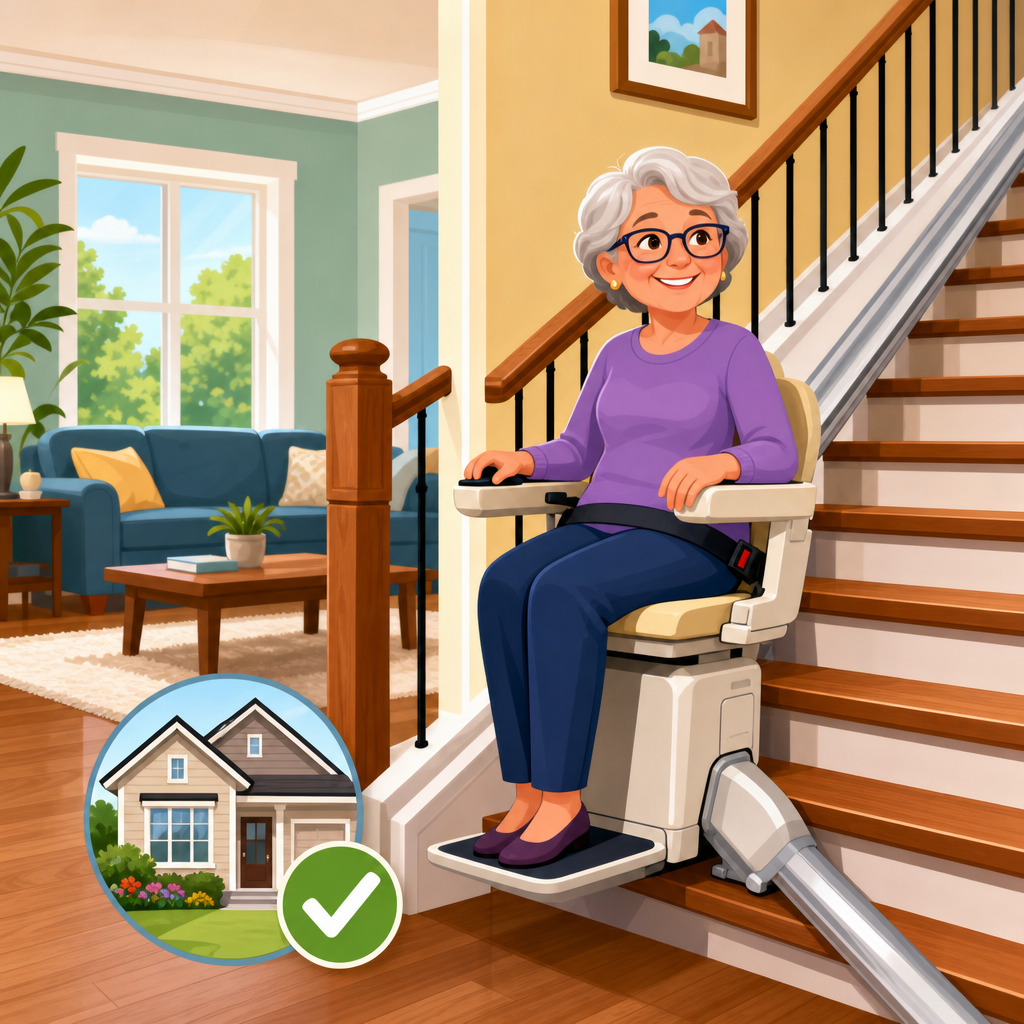
A stair lift is a motorized chair that travels along a rail mounted to the stairs, helping someone move safely between floors without climbing steps. Renting usually means paying an upfront installation or reconditioning fee plus a monthly charge for ongoing use, service, and sometimes removal. Buying means paying the larger upfront cost for the unit and installation, then keeping the equipment as long as needed, with warranty coverage varying by supplier. In practice, I have seen families focus too heavily on sticker price and miss the more important variables: the shape of the stairs, likely duration of need, maintenance terms, and whether a used or refurbished purchase changes the math.
This matters because stair lifts are often arranged under pressure. A hospital discharge, a fall, worsening arthritis, stroke recovery, or a new diagnosis can force a quick decision. When that happens, people understandably choose the option with the lowest immediate payment. Sometimes that is smart. Sometimes it becomes an expensive habit that quietly exceeds the cost of ownership. A hub page on rental vs. purchase should make the economics clear, explain where renting shines, and show when buying is usually the better long-term move.
At a high level, renting works best for short-term mobility needs, uncertain recovery timelines, and straight staircases where inventory is readily available. Buying works best for long-term use, custom curved stairs, and households that want predictable ownership rather than indefinite monthly charges. The break-even point is the month when total rental costs exceed the total cost of buying, adjusted for any resale value, warranty, maintenance, and removal fees. Once you calculate that point honestly, the decision usually becomes much clearer.
What rental vs. purchase actually includes
The first step is comparing equivalent offers. Families often compare a rental quote that includes service and removal with a purchase quote that includes only installation and a short warranty, then conclude the rental is a better deal. That is not a true apples-to-apples comparison. A complete stair lift cost analysis should include equipment, rail, installation labor, service call policy, battery replacement expectations, removal, transfer options if the user moves, and taxes or permit-related costs where applicable.
For a straight stair lift, a rental agreement commonly includes a one-time setup fee ranging roughly from $300 to $1,500 and monthly charges from about $100 to $300, depending on brand, market, and service package. Purchase prices for new straight lifts often range from around $2,500 to $6,000 installed, while refurbished units may land lower. Curved stair lifts are different. Because the rail is built to the staircase, curved rentals are far less common and often much more expensive; new purchases can run from about $10,000 to $20,000 or more, depending on turns, landings, and track complexity.
In real projects, I also look at what “included” means. Some dealers include a comprehensive service plan in rent but charge separately for callouts on purchased units after the initial warranty. Others provide strong lifetime coverage on major components for purchased lifts but limited labor. Reputable brands and dealers usually spell out terms clearly. If they do not, that is a warning sign. The monthly number alone tells you very little without the contract details behind it.
How to calculate the break-even point
The break-even calculation is simple in principle: total rental cost equals upfront rental fee plus monthly rent times the number of months, plus any removal or damage charges not already included. Total purchase cost equals purchase price plus installation, minus any resale value you can realistically recover, plus maintenance costs not covered by warranty. Buying becomes cheaper in the month when the ownership total falls below the rental total.
Here is a practical example for a straight staircase. Suppose a supplier charges $900 upfront to install a rental lift and $175 per month after that, with removal included. After 12 months, the rental total is $3,000. If a comparable new straight stair lift costs $4,200 installed and comes with a two-year warranty, renting is still cheaper at one year. By month 20, rental reaches $4,400, so ownership has become cheaper if you still need the lift. If a refurbished purchase is available for $3,200 installed, the crossover arrives around month 14 instead.
Now consider a more expensive rental market: $1,200 upfront and $225 per month. At 12 months, total rental cost is $3,900. In that scenario, buying a refurbished straight lift at $3,200 beats renting before the first year ends, and even a new $4,200 lift becomes cheaper around month 14. This is why there is no universal answer. The same staircase can yield very different decisions depending on local dealer pricing and whether a quality refurbished unit is available.
| Scenario | Upfront Rental Fee | Monthly Rental | Purchase Price Installed | Approximate Break-Even |
|---|---|---|---|---|
| Straight stair, lower rental pricing | $900 | $175 | $4,200 new | 20 months |
| Straight stair, lower rental pricing | $900 | $175 | $3,200 refurbished | 14 months |
| Straight stair, higher rental pricing | $1,200 | $225 | $4,200 new | 14 months |
| Straight stair, higher rental pricing | $1,200 | $225 | $3,200 refurbished | 9 months |
For curved stair lifts, the break-even point can be less useful because rental inventory is limited and pricing structures vary sharply. In many regions, curved lifts are primarily sold rather than rented because the rail is custom fabricated. If a curved rental is available, ask whether the rail is new, whether it can be re-used if the staircase geometry is common, and whether there are substantial fabrication or removal fees. I have seen cases where a family expected a temporary curved rental to save money, only to discover that custom work made purchase or a home modification alternative more sensible.
When renting a stair lift makes the most sense
Renting is often the right choice when the need is clearly temporary. Common examples include recovery after hip replacement, knee replacement, spinal surgery, a fractured leg, or a short rehabilitation period after hospitalization. If expected use is three to six months, renting usually protects cash flow and avoids paying for equipment you may not need long term. It also reduces commitment when prognosis is uncertain. In discharge planning situations, speed matters, and straight stair lift rentals can often be installed quickly from local stock.
Renting also helps families who are making larger decisions at the same time. A person may be deciding whether to age in place, move a bedroom downstairs, relocate to assisted living, or sell the home. In those situations, a rental creates breathing room. It can function as a bridge while the family tests daily mobility needs in the real environment. I have recommended rentals in cases where the user’s endurance, transfer ability, or cognitive status was still changing. It is better to learn from actual use than buy too early and discover the chosen setup is wrong.
Another good use case is hospice or palliative care where preserving access to the whole home matters, but the expected timeframe is limited. Here, the value of rental is not just financial. It reduces logistical burden because service and removal are usually built into the agreement. If the family needs an immediate accessibility solution without a long planning horizon, rental is often the most practical route.
When buying usually becomes the smarter choice
Buying usually makes more sense when the need will last longer than a year, especially on a straight staircase. Progressive conditions such as Parkinson’s disease, multiple sclerosis, severe osteoarthritis, chronic balance disorders, post-stroke deficits, and cardiopulmonary limitations rarely resolve quickly. In these cases, the household is not solving a short-term recovery problem; it is adapting the home for sustained mobility. Monthly rental fees become a recurring expense with no ownership benefit, and the total cost commonly overtakes purchase within the first or second year.
Purchase is also the default choice for curved stair lifts because the rail is tailored to the staircase. A curved lift must be measured carefully, often using photo measurement or digital surveying, and the track is manufactured for specific turns, parking points, and overrun requirements. Those custom elements are why curved lifts cost more and why rental options are sparse. If the staircase has intermediate landings, spiral geometry, or multiple bends, assume that buying will be the realistic path unless a local specialist explicitly offers a strong rental program.
Households should also consider buying when a quality refurbished lift is available from a reputable dealer. Refurbished does not mean improvised or unsafe. Properly reconditioned units are inspected, tested, fitted with new wear components where needed, and installed with appropriate safety checks. If the dealer backs the unit with warranty and service, refurbished purchase can move the break-even point forward significantly. For many cost-conscious families, it is the best balance between affordability and long-term value.
Factors that change the math beyond monthly price
Several overlooked factors can shift the rental vs. purchase decision. First is staircase type. Straight stairs support the strongest secondary market and the easiest reinstallations, so both rentals and refurbished purchases are more available. Curved stairs drive customization costs. Second is user weight capacity and seat configuration. Heavy-duty models, perch seats, folding rails, powered swivels, and hinged track sections all affect price. Third is home layout. A narrow hall at the bottom landing or a doorway at the top can require features that change both installation complexity and future reuse value.
Service policy matters too. Stair lifts rely on batteries, charge points, limit switches, drive systems, and seat safety circuits. Even reliable brands need occasional attention. If a rental includes labor, parts, and emergency response, while a purchase carries limited labor after the first year, compare the likely service burden realistically. Battery replacement is a normal lifecycle cost, not a sign of product failure. Outdoor lifts add another layer because exposure to moisture and temperature swings increases wear and can narrow the economics of long rentals.
Finally, think about residual value. Some dealers buy back used lifts, accept trade-ins, or can relocate a straight rail system to another home with adjustment. Private resale is possible but less predictable. A conservative resale assumption can improve the ownership case, but it should never be inflated. If a salesperson promises unusually high resale value without a written policy, ignore that number in your decision model.
Questions to ask before choosing rental or purchase
Before signing, ask five direct questions. One: what is the total cost over 6, 12, and 24 months, including installation, service, and removal? Two: is the staircase straight or curved, and does that limit rental availability? Three: what warranty applies to a purchased lift, and what labor is covered? Four: is a refurbished stair lift available, and how has it been reconditioned? Five: if needs change, what are the options for removal, buyout, transfer, or trade-in?
It also helps to involve the right professionals. Occupational therapists can assess transfer safety and seating needs. Discharge planners can clarify likely recovery timelines. Local dealers can explain whether a narrow stair, offset doorway, or multiple users changes the recommended model. In my experience, the best decisions happen when families combine clinical expectations with a written cost comparison instead of relying on assumptions.
Choosing between stair lift rental and purchase comes down to duration, staircase design, and total cost, not just the lowest initial payment. Renting is usually best for short-term recovery, uncertain timelines, and fast access on straight stairs. Buying is usually better for long-term mobility needs, for most curved staircases, and whenever monthly rental fees would exceed ownership within a year or two. The typical break-even point for straight lifts often falls between 8 and 18 months, but your local pricing and warranty terms can move that number meaningfully.
The biggest mistake is delaying the calculation. When families compare full-life costs early, they avoid overpaying for convenience or committing too much cash too soon. They also choose equipment that fits the user and the staircase instead of forcing a quick decision around a single monthly figure. If you are weighing rental vs. purchase, get itemized quotes for both options, ask for 12-month and 24-month totals, and compare new and refurbished models side by side before you decide.
Frequently Asked Questions
How long can you usually rent a stair lift before buying becomes the cheaper option?
In many cases, the financial crossover point falls somewhere between 8 and 18 months, but that is only a general guideline. The exact break-even timeline depends on the type of stair lift, the shape of the staircase, the upfront installation costs, the monthly rental fee, and whether the equipment can be reused easily by the provider. A straight stair lift on a standard staircase often has a lower installation cost and a more predictable rental structure, so the rent-versus-buy comparison is usually more favorable and easier to calculate. A curved stair lift, by contrast, often requires a custom rail and more specialized setup, which can change the economics significantly.
It also matters why the lift is needed. If someone is recovering from surgery, a fall, or a short-term medical issue, renting often makes sense even if the monthly cost is relatively high, because it avoids a larger upfront purchase. If the need is likely to continue long term due to aging in place or a progressive mobility condition, buying may become the better value much sooner. The best way to judge the timing is to compare the full cost of renting over the expected usage period against the total cost of ownership, including installation, warranty, service, and any potential resale or buyback value.
What factors affect whether renting or buying a stair lift is the better financial choice?
Several variables determine whether renting remains cost-effective or whether buying starts to make more sense. The biggest factor is staircase type. Straight stair lifts are usually less expensive to install and are more commonly available as rental units, which keeps monthly costs relatively manageable. Curved stair lifts are typically custom-built for the home, so rental options may be limited or more expensive, and that can make purchasing the more practical option sooner than many people expect.
Equipment type matters too. Basic models with standard seats and controls generally cost less than heavy-duty lifts, outdoor lifts, or lifts with premium features such as powered swivel seats, folding rails, or advanced safety systems. Another major factor is the rental agreement itself. Some companies charge a modest installation fee and a higher monthly rate, while others spread more of the cost across setup and removal. Maintenance coverage is also important. If service calls, repairs, and routine maintenance are included in the rental, that can add real value and reduce surprise expenses. On the ownership side, you should look at purchase price, installation charges, warranty length, expected servicing costs, and whether the unit has any resale potential. When all of those pieces are reviewed together, the better choice becomes much clearer.
Is renting a stair lift better for short-term needs like surgery recovery or rehabilitation?
Yes, in many short-term situations, renting is often the most sensible choice. If the expected need is measured in weeks or a few months rather than years, renting can provide immediate access to the equipment without requiring a large upfront investment. This is especially helpful after knee replacement, hip surgery, injury recovery, or other temporary mobility limitations where the goal is to make the home safer during a defined healing period. Instead of paying the full purchase price for a lift that may only be needed briefly, the household can use it for the necessary period and then have it removed.
Renting also reduces the burden of ownership during an already stressful time. Many rental arrangements include service and maintenance, which means if a problem comes up, the provider typically handles it without the customer worrying about repair logistics. That said, families should still look closely at the terms. If recovery is uncertain and there is a real possibility that the stair lift will be needed for a year or longer, buying may start to become more economical. The key is to match the rental period to a realistic medical timeline rather than an overly optimistic one. When the need truly is temporary, renting is often the more flexible and lower-risk decision.
Why is the break-even point so different for straight and curved stair lifts?
The difference comes down to customization and cost structure. Straight stair lifts are designed for staircases that go in a single line without turns, landings, or complex bends. Because the rail is standard and can often be reused in another home, providers are generally more willing to offer rental programs on these models. Installation is usually simpler, faster, and less expensive, which helps keep the overall rental cost more competitive.
Curved stair lifts are much different. They are built to fit the exact dimensions and layout of a staircase with turns, intermediate landings, or spiral-like features. That custom rail is a major cost driver, and it is not as easily reused in another property. As a result, rental programs for curved lifts may involve much higher setup costs, limited availability, or pricing that makes the rental-versus-buying calculation tilt toward ownership sooner. In other words, two households may both need a stair lift, but the one with a straight staircase may find renting economical for longer, while the one with a curved staircase may reach the buy-is-cheaper point much faster. That is why homeowners should avoid relying on generic national averages and instead request quotes tailored to their staircase.
How should you compare stair lift rental quotes to decide when buying becomes cheaper?
The best approach is to compare total cost over time rather than focusing only on the monthly rental number. Start by listing every rental expense: installation, delivery, monthly fee, service coverage, removal, and any minimum rental term. Then compare that with the full cost to buy, including equipment, installation, warranty, maintenance obligations after the warranty ends, and any financing charges if applicable. Once you have those figures, calculate what the rental would cost at 3 months, 6 months, 12 months, 18 months, and beyond. That step-by-step comparison usually makes the crossover point obvious.
It is also wise to ask practical questions that affect value. Does the rental include repairs? Is there an extra fee if the user keeps the lift longer than expected? Is there a rent-to-own option that applies some payments toward a purchase? If you buy, can the stair lift be resold, repurchased by the dealer, or transferred to another home? Beyond cost, consider certainty of need. If the household expects long-term use, buying may deliver better value and more stability. If the duration is unclear, renting can serve as a lower-commitment way to meet immediate mobility needs. A careful side-by-side comparison of both the financial and practical terms is the most reliable way to know exactly when buying becomes the cheaper choice.