Training a caregiver on chair lift safety starts with one goal: helping a person move between floors reliably, comfortably, and without preventable risk. In accessibility and mobility solutions, a chair lift is a motorized seat that travels along a rail mounted to a staircase, while caregiver support resources include the instructions, checklists, emergency procedures, maintenance guidance, and communication habits that make everyday use safe. I have trained families, home health aides, and facility staff on stair lifts in private homes and assisted living settings, and the same pattern appears every time: accidents usually come from rushed transfers, weak onboarding, or assumptions that “the lift is simple.” It is simple only when training is structured. This matters because falls on stairs remain a major source of injury for older adults, and a chair lift often serves users with limited balance, arthritis, stroke effects, Parkinsonian symptoms, or post-surgical weakness. Proper caregiver training protects the rider, reduces equipment misuse, preserves manufacturer warranty conditions, and builds confidence for daily routines. A strong training program also turns this article into a practical hub for caregiver support resources by connecting safe operation with assessment, communication, emergency planning, and follow-up.
Start with a safety-first assessment of the rider, staircase, and device
The first step in chair lift safety training is assessing three things together: the rider, the home environment, and the specific lift model. Caregivers should never learn “chair lifts” in the abstract. They need training on the exact unit installed, such as a Bruno, Handicare, Harmar, Savaria, or Stannah model, because controls, swivel mechanisms, diagnostic lights, folding footrests, and battery backup behavior differ. Begin by reviewing the owner’s manual and installation paperwork, then confirm the lift’s weight capacity, seat width, rail placement, charging points, and any powered options. A caregiver must know whether the rider can sit independently, needs a gait belt for transfers, has one-sided weakness, experiences cognitive impairment, or has visual deficits that affect boarding. A narrow staircase, thick carpet edge, nearby door swing, or poor lighting can change the safe approach completely.
In practice, I ask caregivers to perform a simple pre-use scan before every shift. Is the staircase clear of shoes, laundry, pet toys, and oxygen tubing? Is the seat locked in the travel position? Is the armrest down if the manufacturer requires it? Is the footrest free of obstruction? Are the remote controls stored in a consistent place? If the unit uses battery charging contacts at the top or bottom landing, is it parked correctly to recharge? This type of environmental awareness belongs at the front of training because many service calls are not mechanical failures. They are preventable issues caused by blocked safety edges, drained batteries, or users leaving the seat swiveled away from its locked position.
Teach the core operating sequence the same way every time
Caregiver support resources work best when they standardize behavior. A chair lift should be operated in a fixed sequence so the caregiver can repeat it under stress without skipping steps. The sequence is straightforward: prepare the landing, position the chair, assist the transfer, secure the rider, travel without interference, and unload at the destination. Explain each action in plain terms. Preparation means checking lighting, clearing the landing, and confirming the seat is fully lowered and facing the correct direction. Positioning means using the call/send control if the lift is parked on the opposite floor, then waiting until it stops completely before touching the rider. Assistance with transfer means cueing the rider to back up until they feel the seat, reach for armrests rather than the rail or wall, and sit centered with hips fully back.
After seating, the caregiver should lower the footrest if it is not automatic, ensure both feet are placed correctly, and apply the seat belt every single ride. This should not be optional, even for short distances. During travel, caregivers should keep hands, blankets, bags, and mobility aid straps away from the rail and stair edge. At the top landing, the caregiver should wait for full stop, then swivel the seat only as designed and verify the swivel lock engages before asking the rider to stand. The safest verbal cue is simple: “Nose over toes, push from the armrests, stand, pause, then step away from the stairs.” Consistent cueing reduces hesitation and unsafe grabbing. If the rider uses a walker, it should already be positioned on the destination landing, never balanced across steps or reached for mid-transfer.
Build transfer skills because most risk happens getting on and off
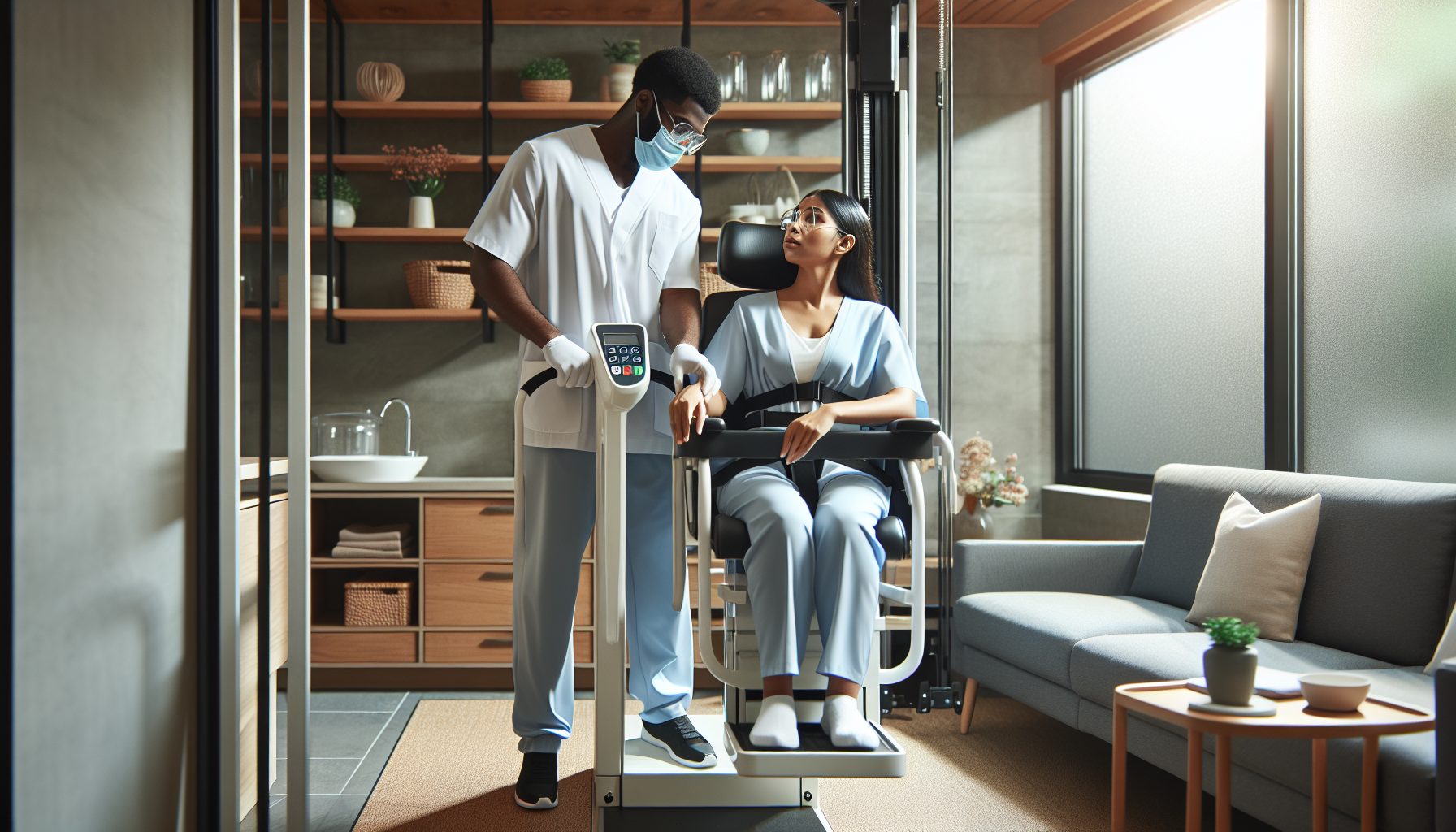
The ride itself is usually the easiest part. Transfers create the highest risk because they combine weakness, fear, timing, and the edge of a staircase. That is why caregiver support resources should devote more time to transfers than to button pushing. Train caregivers to use transfer principles that align with physical therapy practice: stable footwear, close guarding, clear verbal instructions, and no twisting under load. If the rider needs hands-on help, stand to the side and slightly in front, not on a lower stair where leverage is poor. Use a gait belt when appropriate and when the person’s care plan allows it. The caregiver should avoid pulling the rider by the arms, which can injure shoulders, especially after stroke or in frail older adults.
Real-world examples help. A person with knee osteoarthritis may need the chair seat raised, if the model permits, or extra cueing to scoot forward before standing. A person with left hemiparesis after stroke may need the stronger side positioned toward the armrest used for push-off. Someone with dementia may try to stand before the lift reaches the landing, so training must include close supervision, calm one-step instructions, and possibly environmental prompts such as a contrasting strip on the landing floor. In homes where a caregiver assists a bariatric user, the trainer should review rated capacity, seat dimensions, and whether a heavy-duty model was installed. Never improvise beyond the manufacturer’s stated limits. If transfers remain unsafe despite training, the answer is not “be more careful.” The answer may be reassessment by occupational therapy, physical therapy, or the lift provider.
Cover emergency procedures, troubleshooting, and when to stop using the lift
A caregiver should know exactly what to do when the lift stops, alarms, or behaves unexpectedly. This is where many families feel unprepared, and it is where good training sharply reduces panic. Start by teaching the difference between routine interruption and equipment fault. Most modern stair lifts have obstruction sensors on the footrest or carriage. If the lift stops mid-travel, the caregiver should release the control, check for items touching the footrest or carriage, and restart only after the obstruction is removed. If the lift will not move, verify the seat is locked in travel position, armrests are correctly placed if required, and the key switch is on if the unit uses one. Then check battery charging status. Because many lifts are battery powered, they can still run during a household power outage for a limited number of trips, but only if they were charging properly beforehand.
Caregivers also need hard stop rules. Stop using the lift and call the dealer or service provider if the seat wobbles, the rail loosens, unusual grinding begins, the unit jerks, safety edges trigger without visible obstruction, the swivel lock fails, or diagnostic indicators show a persistent fault. Do not attempt home repairs beyond the manual’s permitted user checks. Stair lifts are safety devices, not general household appliances. The training packet should include the manufacturer name, model number, installation company, emergency contact, service contract details, and location of the manual. In my experience, posting a one-page troubleshooting guide near the top landing saves time and reduces unsafe improvisation. The caregiver should also know how to move the rider away from the staircase and into a safe seated position if the lift cannot be used, especially if there is no alternate bedroom or bathroom on the main floor.
Create a caregiver checklist and documentation routine
One reason training fails is that it lives in memory instead of process. A documented routine improves consistency across family members, private aides, and agency staff. For a hub page on caregiver support resources, this is essential because the checklist becomes the bridge to related topics such as home safety audits, fall prevention, maintenance schedules, and mobility care plans. Use a simple written form for orientation and a shorter one for daily use. Orientation should document that the caregiver reviewed the manual, demonstrated boarding and disembarking, used the call/send control, identified charging points, explained emergency steps, and practiced with the rider under supervision. Daily use should capture only critical items: path clear, battery charging, seat belt used, rider tolerance, and any unusual sounds or stops.
| Training Item | What the Caregiver Must Demonstrate | Why It Matters |
|---|---|---|
| Pre-use inspection | Check staircase, landing, footrest, rail, seat position, and charging status | Prevents obstruction stops, battery drain, and trip hazards |
| Safe transfer onto seat | Guard closely, cue the rider, center hips, place feet, and avoid twisting | Reduces falls and shoulder or back strain |
| Ride procedure | Fasten seat belt, keep limbs clear, travel without rushing or touching moving parts | Protects rider during movement and preserves equipment |
| Unload at landing | Wait for full stop, lock swivel, assist stand, and position walker before transfer | Most incidents occur at the landing, not mid-ride |
| Emergency response | Identify obstruction, check seat lock and power, stop use for faults, call service | Prevents unsafe troubleshooting and delayed repairs |
Documentation also helps with continuity. If one aide notices that the rider is pushing up less effectively or increasingly forgets the seat belt, the next caregiver can adjust supervision. Agencies should incorporate stair lift competency into onboarding and annual refresher training, just as they would for Hoyer lifts or wheelchair transport. Families can use a simplified version, but the principle is the same: written routines catch drift before drift becomes danger.
Use communication, practice, and refreshers to make safety stick
Even excellent initial instruction fades without reinforcement. Chair lift safety should be taught using demonstration, return demonstration, and scenario practice. I typically model the full sequence once, then have the caregiver perform it while narrating each step, then repeat under a slightly more realistic condition such as managing a blanket, retrieving a walker, or cueing a nervous rider. This approach reveals hidden gaps fast. A caregiver may know how to send the lift but forget to verify the swivel lock, or remember the seat belt but leave the footrest folded. Adults retain procedures better when they speak them aloud and practice in the exact environment where they will work.
Communication with the rider matters just as much as mechanical skill. Caregivers should use short, consistent phrases before each transfer and avoid overloading the rider with multiple instructions. Ask one question that confirms readiness: “Are you comfortable and ready to go up?” For riders with hearing loss, face them directly and reduce background noise. For riders with cognitive impairment, maintain routine and avoid changing the process from day to day. Refreshers should happen after any hospitalization, fall, medication change, decline in strength, or equipment service visit. New pain, dizziness, orthostatic hypotension, or sedation can make a previously safe routine unsafe. When that happens, retraining is not optional. It is part of responsible caregiving.
Effective chair lift safety training gives caregivers a repeatable system, not just a quick lesson on buttons. The essential elements are clear: assess the rider and the exact device, teach a fixed operating sequence, focus intensely on transfers, prepare for faults and emergencies, document competency, and refresh skills whenever conditions change. When these caregiver support resources are in place, the lift becomes what it should be: a dependable accessibility tool that reduces stair risk and supports independence at home. The biggest benefit is confidence grounded in procedure. Riders feel safer, caregivers make fewer errors, and families spend less time reacting to avoidable problems. If you manage a home care plan under accessibility and mobility solutions, use this page as your hub, then build a written checklist, schedule a hands-on practice session, and review the manufacturer’s manual before the next ride.
Frequently Asked Questions
What should a caregiver learn first when being trained on chair lift safety?
A caregiver should start with the fundamentals: how the specific chair lift works, who is authorized to use it, and what conditions must be met before every ride. That means understanding the main parts of the lift, including the seat, armrests, footrest, seat belt, controls, rail, charging points, swivel function, and any obstruction sensors. The caregiver should also know the user’s mobility level, balance limitations, transfer needs, cognitive status, and any medical concerns that could affect safe use, such as dizziness, weakness, or poor trunk control. Training should begin with the manufacturer’s instructions and then move into the home’s day-to-day routine, because safe operation depends on both technical knowledge and practical habits.
Before a caregiver assists with the first ride, they should be able to complete a pre-use check confidently. This includes making sure the staircase is clear, the chair is fully charged if applicable, the seat is locked in the proper position, the footrest is unfolded, the armrests are secure, and the seat belt functions correctly. They should also confirm that the user is wearing stable footwear and clothing that will not catch on the lift. If the chair lift has call/send controls, the caregiver should know how to bring the chair to the correct floor and position it safely for boarding. Good training also includes reviewing weight capacity, safe riding posture, and what to do if anything seems unusual, such as jerky movement, beeping, slow travel, or failure to stop where expected.
Most importantly, the caregiver should understand that chair lift safety is not only about pressing a button. It is about managing the entire transfer process from approach to seating to arrival and exit. The safest training programs teach the caregiver to slow down, follow the same sequence every time, communicate clearly with the rider, and never improvise around a malfunction. Establishing these habits early greatly reduces preventable risk and helps the rider feel secure and respected.
How should a caregiver assist someone getting on and off a chair lift safely?
Safe boarding and exiting are the parts of chair lift use where many avoidable problems happen, so this portion of training should be very hands-on. The caregiver should first position the chair correctly at the landing, making sure it is fully stopped and, if the lift has a swivel seat, turned and locked to allow a safer transfer away from the stairs. The user should approach with any prescribed mobility aid, such as a cane or walker, placed in a way that supports balance without blocking the transfer. The caregiver should cue the rider step by step: back up until the legs touch the seat, reach for the armrests if appropriate, sit down slowly, place both feet securely on the footrest, and fasten the seat belt before the ride begins. During training, caregivers should practice giving calm, consistent verbal instructions that match the rider’s abilities and confidence level.
Exiting follows the same principle: stop completely, confirm the chair is in the correct position, swivel and lock the seat if that feature exists, remove the seat belt, and help the rider stand only when balance and foot placement are stable. Caregivers should avoid rushing the transfer, pulling on the rider’s arms, or allowing the rider to stand while the chair is not properly positioned. If hands-on help is needed, training should include proper body mechanics and transfer technique so the caregiver protects both the rider and themselves. This is especially important if the rider needs contact guard assistance, has one-sided weakness, or fatigues easily.
Caregivers should also be taught to watch for subtle warning signs during transfers, such as sliding forward in the seat, poor foot placement, confusion about instructions, shortness of breath, or fear that causes sudden movement. These signs may indicate the routine needs to be adjusted, the user needs more support, or another mobility solution should be considered. A well-trained caregiver treats every transfer as a safety task, not a minor step before the “real” use of the lift. In practice, safe transfers are the real foundation of chair lift safety.
What daily safety checks and maintenance habits should a caregiver follow?
A caregiver does not need to be a repair technician, but they do need to perform routine safety checks and recognize when professional service is needed. Daily or regular checks should include inspecting the stairs and landing areas for clutter, loose rugs, cords, spills, pet toys, or anything else that could interfere with access to the lift. The caregiver should verify that the seat, armrests, footrest, and seat belt are in good condition and that the controls respond normally. They should listen for unusual sounds, note slower-than-normal movement, and confirm that the lift charges properly at its designated points. If the unit has diagnostic lights, alarms, or battery indicators, the caregiver should know what they mean and when to report them.
Training should emphasize that routine cleaning and maintenance must follow manufacturer guidance. The rail should be kept clean as recommended, but caregivers should not apply random lubricants, attempt electrical repairs, or force a component that feels stuck. They should know the service schedule, where the owner’s manual is kept, who to call for technical support, and how to document problems. In homes with multiple caregivers, a simple checklist can be extremely helpful. It creates consistency and ensures small issues are noticed early instead of being missed during shift changes or busy routines.
One of the most important habits is knowing the difference between a minor usability issue and a potential safety hazard. For example, a twisted seat belt, weak remote battery, or object blocking the footrest sensor may be manageable with routine troubleshooting, while intermittent stopping, exposed wiring, a loose seat, or repeated fault alarms require immediate removal from service until inspected by a qualified professional. Training caregivers to stop use when something is not right is a key part of accident prevention. A chair lift is a mobility device, but it is also a piece of powered equipment, and that means caution, observation, and timely service matter every day.
How should a caregiver respond if the chair lift stops working or there is an emergency?
Emergency response training should be specific, calm, and practiced in advance. A caregiver should know exactly what to do if the lift stops mid-staircase, loses power, shows an error, or the rider becomes distressed. The first priority is to keep the rider calm and seated securely. In most cases, the rider should remain seated with the seat belt fastened unless the manufacturer’s instructions and the situation clearly support another action. The caregiver should reassure the rider, check for obvious issues such as an obstruction on the stairs or footrest, and follow the approved troubleshooting steps from the manual or provider. Many lifts have battery backup, diagnostic indicators, or manual lowering procedures, but those features vary by model, so training must be lift-specific rather than generic.
Caregivers should also be taught what not to do. They should not try to force the chair, bypass safety features, dismantle parts, or attempt an unsafe evacuation on the staircase unless there is an immediate life-threatening emergency such as fire. If the lift cannot be restored quickly and safely, the caregiver should contact the service provider or emergency contact listed in the home’s support plan. In homes where the rider has significant medical needs, the emergency plan should include who to call, where backup mobility equipment is kept, and how to communicate the problem clearly to family members, supervisors, or emergency responders.
The best emergency plans are written down and reviewed regularly. A caregiver should know the location of the manual, service number, emergency contacts, and any instructions for power failures. They should also understand the rider’s personal emergency risks, including panic, confusion, pain with prolonged sitting, or medical conditions that require timely assistance. Practicing scenarios during training helps caregivers respond more effectively under stress. When a caregiver knows the plan in advance, they are far more likely to protect the rider’s safety, preserve dignity, and avoid making a difficult situation worse.
How can a caregiver make chair lift use safer and more comfortable over the long term?
Long-term chair lift safety depends on consistency, communication, and regular reassessment. A caregiver should use the same safe sequence each time, because repetition reduces mistakes and gives the rider confidence. Clear communication is especially important: let the rider know what is happening before each step, confirm they are ready before starting the lift, and encourage them to speak up about pain, fear, dizziness, or anything that feels different. Some riders become less stable, more fatigued, or more anxious over time, and these changes can affect safe use even if the lift itself is functioning perfectly. Training caregivers to notice these shifts helps prevent gradual decline from turning into a sudden incident.
Comfort is also part of safety. If a rider feels rushed, insecure, or physically awkward on the lift, they may lean, twist, grab unsafely, or try to stand too soon. Caregivers should be taught to check seating posture, foot placement, and belt fit every time. They should also monitor whether the lift’s configuration still matches the user’s needs. A person who now needs more transfer help, has developed joint stiffness, or uses a different mobility aid may require updated instruction from the installer, therapist, nurse, or physician. In some cases, the issue is not just training but whether the current setup is still appropriate.
Finally, long-term safety improves when caregivers, family members, and professionals share observations. Keep a simple log