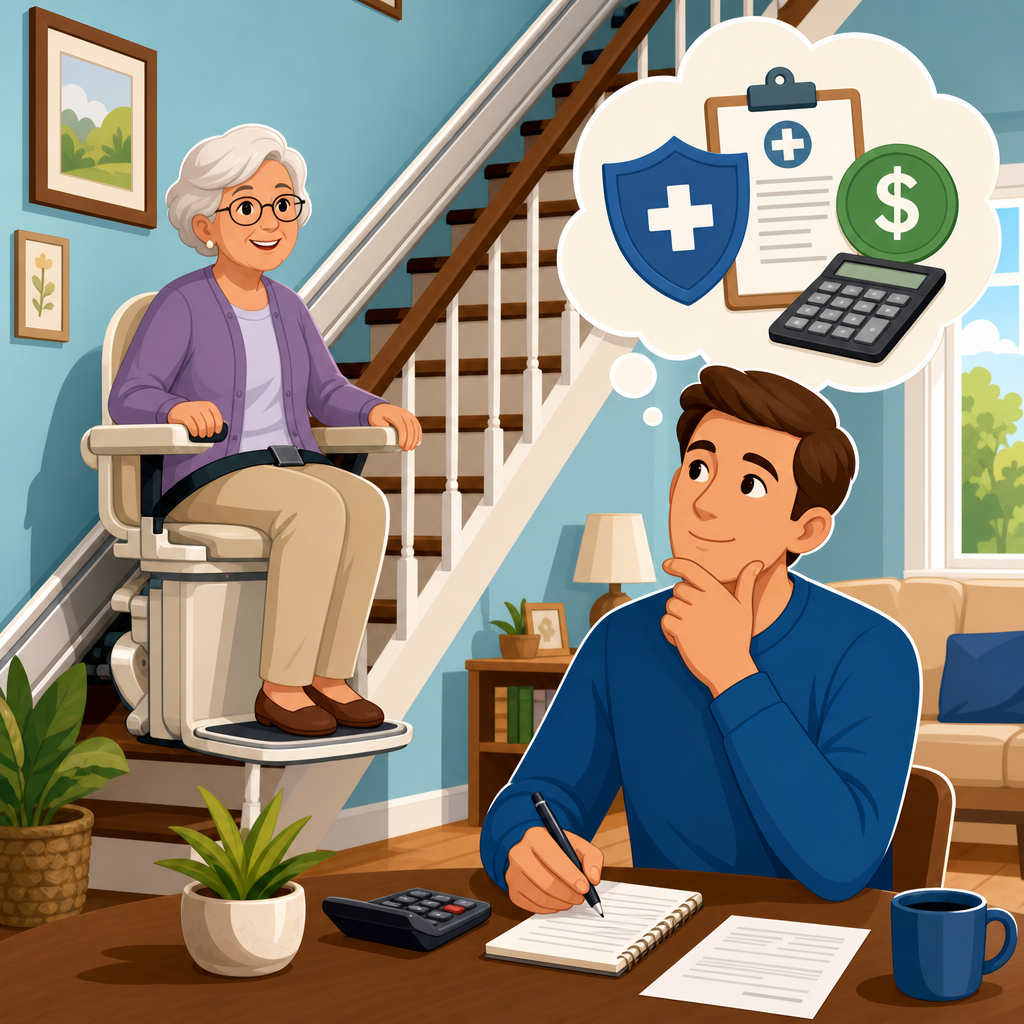
Monthly payment estimates for common chair lift models help families turn a large mobility purchase into a predictable budget item, which is often the difference between delaying a needed installation and making a safe home access decision now. In this guide, I will break down how financing and payment plans usually work for stair chair lifts, what monthly costs look like across common models, and which variables change the final payment. A chair lift, often called a stair lift, is a motorized seat that travels along a rail attached to a staircase, allowing a person with limited mobility to move between floors safely. Monthly payment estimates matter because the advertised purchase price rarely tells the full story. Rail type, staircase shape, seat upgrades, installation complexity, service coverage, and lender terms can all raise or lower the amount due each month.
Families typically start with one question: what will this cost per month? The useful answer is not a single number but a realistic range based on the type of lift being considered. Straight stair lifts, which run on a simple staircase without turns or intermediate landings, are usually the most affordable and quickest to install. Curved stair lifts, which require a custom rail, cost more because they involve detailed measurement, fabrication, and often longer lead times. Outdoor stair lifts add weather-resistant components and protective covers. Heavy-duty models support higher weight capacities and often need a wider staircase. Standing or perch lifts solve a narrower mobility need and may change seat and rail specifications. Each model category has a different financing profile.
I have worked with homeowners comparing dealers, reviewing proposals, and trying to reconcile the sales quote with the lender disclosure. The same lift can look affordable on one quote and expensive on another simply because the financing structure is different. A dealer may promote a low monthly number over a long term, while another offers a shorter term with less total interest. Some plans are manufacturer-backed promotional offers with deferred interest or limited-time rates. Others are unsecured personal loans, home improvement loans, or financing through medical equipment lenders. Understanding these structures is essential because a low monthly payment is not always the lowest overall cost, and the fastest approval is not always the best fit for a retiree on fixed income.
This article serves as a hub for financing and payment plans under the broader cost and financing topic. It is designed to answer the core questions people ask before they sign: how much is a straight chair lift per month, what changes the payment, are used or rental lifts worth financing, can Medicare help, and how should you compare plans from different providers? By the end, you should be able to estimate a likely monthly payment range, spot the tradeoffs inside financing offers, and move to model-specific and lender-specific research with a stronger baseline.
How monthly chair lift financing is calculated
Monthly payments are driven by five variables: purchase price, down payment, interest rate, term length, and fees. Purchase price is the installed cost of the lift, including rail, seat, power supply, and labor. A down payment reduces the amount financed. The interest rate, often expressed as APR, determines borrowing cost over time. Term length spreads repayment across months, usually from 12 to 84 months. Fees can include origination charges, administrative charges, or prepaid service plans bundled into the loan. When I review offers, I focus on the amount financed and total repayment first, then monthly payment second. That sequence prevents buyers from choosing a comfortable monthly number that hides a high total cost.
For example, a $4,000 straight stair lift financed for 36 months at 9.99% APR produces a monthly payment around $129. Stretch the same amount over 60 months and the monthly payment drops to about $85, but the total interest paid rises meaningfully. A $12,000 curved lift financed over 60 months at 11.99% APR lands near $267 per month. Add an extended warranty, powered swivel seat, and folding rail, and the financed amount can increase by $1,500 to $3,000. Small quote changes become visible very quickly when they are converted into monthly payment impact.
Payment plans also differ in structure. Traditional amortizing loans apply part of each payment to principal and part to interest. Promotional same-as-cash plans may charge no interest if paid within a short period, but deferred-interest terms can become expensive if a balance remains after the promo window. Rental plans, common for temporary recovery needs, work more like monthly service subscriptions with installation and removal fees. Lease-to-own programs exist in some markets but require close review because the effective cost can exceed a conventional loan. The right structure depends on whether the need is temporary, long term, urgent, or tied to anticipated home changes.
Monthly payment estimates for common chair lift models
The ranges below reflect typical installed prices in the U.S. market, then translate those costs into approximate monthly payments using common financing assumptions. Actual pricing varies by region, staircase design, dealer labor rates, and brand. Well-known manufacturers in this category include Bruno, Stannah, Harmar, Handicare, Savaria, and Acorn. Dealers may also offer reconditioned inventory or rental fleets that shift the numbers. Use these estimates as planning benchmarks, not as binding quotes.
| Chair lift model type | Typical installed cost | Estimated monthly payment | Common financing example |
|---|---|---|---|
| Straight stair lift | $2,800 to $5,500 | $80 to $175 | 36 to 60 months at 8% to 12% APR |
| Curved stair lift | $9,500 to $17,000 | $210 to $420 | 48 to 84 months at 8% to 13% APR |
| Outdoor stair lift | $4,500 to $8,500 | $110 to $240 | 36 to 60 months at 8% to 12% APR |
| Heavy-duty stair lift | $5,000 to $9,000 | $125 to $255 | 36 to 60 months at 8% to 12% APR |
| Standing or perch lift | $4,000 to $7,500 | $100 to $210 | 36 to 60 months at 8% to 12% APR |
| Reconditioned straight lift | $2,000 to $3,500 | $60 to $120 | 24 to 48 months at 8% to 14% APR |
| Rental straight lift | $300 to $1,500 upfront plus monthly rental | $100 to $250 rental | Month-to-month, often no loan |
Straight stair lifts usually deliver the lowest monthly payment because the rail is standardized and installation is faster. Many homeowners can get a straight unit installed in a day, and some dealers maintain local stock for quick turnaround. Curved lifts are the opposite. Every bend, landing, and parking position adds engineering and manufacturing cost. If your staircase has a 90-degree turn, a mid-landing, or a spiral-like shape, expect the monthly number to move sharply higher. Outdoor lifts sit between straight and heavy-duty pricing, but harsh climates may justify extra service coverage. Reconditioned units can lower the monthly burden, especially for straight stairs, though warranty length may be shorter.
What affects your monthly payment most
The biggest cost driver is staircase configuration. In practice, straight versus curved is the first pricing fork. After that, the most important variables are weight capacity, power features, and installation challenges. A powered swivel seat helps users exit more safely at the top landing, but it raises equipment cost. A powered folding footrest improves convenience but adds more moving parts. A folding rail at the bottom of the stairs prevents the rail from blocking a doorway or walkway, and it is one of the most common upgrades that changes financing totals.
Brand and dealer support matter too. Premium brands often price higher because they offer broader dealer networks, more custom options, and stronger service infrastructure. That can be worthwhile. I have seen cheaper quotes lose their advantage after buyers discover limited local maintenance support or long waits for parts. Battery-backed DC systems are now standard on many models because they continue operating during a power outage, but battery replacement remains a periodic maintenance cost. If the financing package includes a service plan, clarify whether batteries, labor, and annual tune-ups are covered.
Credit profile also affects the monthly number. Applicants with stronger credit may qualify for lower APRs or promotional financing. Those with thinner credit files may see higher rates, shorter terms, or a required co-borrower. Some dealers work with multiple lending partners, which can help. Ask whether a prequalification uses a soft credit inquiry and whether rate shopping across their network triggers one or several hard pulls. The financing mechanics are not as visible as the chair lift itself, but they directly shape affordability.
Comparing financing options and payment plans
The most common funding routes are dealer financing, personal loans, credit cards with promotional APRs, home equity products, and cash payment. Dealer financing is convenient and often the fastest route to installation. The drawback is that convenience can obscure the total borrowing cost. Personal loans from banks, credit unions, or online lenders may offer competitive fixed rates and transparent repayment schedules. Credit unions are often strong options for retirees and homeowners who want lower fees and local underwriting. Promotional credit cards can work for smaller straight lifts if the balance will be paid before the promotion ends, but they are risky for buyers who need longer repayment.
Home equity loans and HELOCs may carry lower rates than unsecured loans because the home secures the borrowing. However, they take longer to arrange, involve closing steps, and put the property at risk if payments are missed. For an urgent accessibility need, that delay can be unacceptable. Cash payment avoids interest entirely and often gives negotiating leverage on installation or service bundles. Yet paying cash is not automatically best if it drains emergency reserves needed for caregiving, medication, or home repairs. A balanced financing choice protects both mobility and liquidity.
When comparing offers, request the same data from every provider: installed price, amount financed, APR, term, monthly payment, total of payments, warranty, service response expectations, and any penalties for late payment or early payoff. If one quote is lower, verify whether it excludes electrical work, permit fees, rail overruns, removal of existing carpet trim, or post-installation service. This is the kind of detail that changes a quote from apparently cheap to genuinely competitive.
Insurance, public programs, and manufacturer assistance
Many buyers assume Medicare will cover a chair lift. Original Medicare typically does not cover stair lifts because they are considered home modifications rather than durable medical equipment under standard rules. Medicare Advantage plans may offer limited supplemental benefits in some cases, but coverage is inconsistent and usually not enough to rely on without confirmation. Medicaid waiver programs in some states can help fund home accessibility modifications for eligible individuals, especially when the modification reduces institutional care needs. Veterans may have access to grants or assistance through programs tied to service-connected disabilities and home modification needs.
State assistive technology programs, Area Agencies on Aging, nonprofit grants, and local disability organizations can sometimes offset part of the cost. These sources rarely eliminate the need for financing, but even a modest grant can lower the amount financed and reduce the monthly payment. Manufacturers and dealers also occasionally run promotions such as free installation, temporary low APR offers, or discounted upgrades. The key is to confirm the real value. A free installation offer on a highly marked-up unit is not better than a lower all-in price with transparent financing.
For buyers building a full affordability plan, reimbursement timing matters as much as eligibility. If a grant pays after installation rather than before, you may still need bridge financing. Ask whether the dealer has experience coordinating with waivers, veterans benefits, or nonprofit funding. Experienced dealers often know which documentation speeds approval and which programs in the region are realistic rather than theoretical.
How to choose the right payment plan for your household
The best payment plan matches the expected duration of need, the user’s safety requirements, and the household budget. If the need is temporary after surgery, a rental may be more economical than financing a purchase, especially for a straight staircase. If the home will be occupied for years and the user’s mobility decline is permanent, ownership usually makes more financial sense. For curved stairs, rentals are less common because custom rails limit reuse, so financing a purchase is often the practical path.
I advise families to set a monthly comfort ceiling before discussing lenders. Start with the maximum payment that fits alongside medications, in-home care, insurance, and utility costs. Then ask dealers to quote models and terms that stay under that ceiling without using excessively long repayment periods. A payment that fits today but stretches to seven years may outlast the equipment’s most valuable period of use. Also ask about resale, buyback, or removal options. Straight lifts can sometimes be repurchased or reconditioned by dealers, which changes long-term value.
Before signing, read the lender disclosure and installation contract separately. Confirm the cancellation policy, the date interest begins, the warranty start date, and who handles service if the dealer changes ownership. A well-chosen chair lift financing plan does more than spread out cost. It makes a safety upgrade attainable without creating unnecessary financial strain. If you are comparing quotes now, use the payment ranges in this guide to benchmark straight, curved, outdoor, heavy-duty, perch, reconditioned, and rental options, then gather itemized proposals from reputable local dealers and lenders before choosing the plan that fits your home and budget.
Frequently Asked Questions
What is a typical monthly payment for a chair lift?
A typical monthly payment for a chair lift depends on the model, the stair layout, the total installed price, the down payment, the loan term, and the buyer’s credit profile. In many cases, a basic straight stair lift financed over several years may fall into a lower monthly range than a custom curved unit, simply because the equipment and installation are less complex. Families often find that entry-level straight models create the most manageable payments, while premium lifts with upgraded seats, folding rails, power swivel features, or custom track work can raise the monthly amount noticeably.
As a practical guideline, monthly estimates are usually easiest to understand when broken into model categories. A standard straight chair lift often produces the lowest payment because it uses a simpler rail and generally requires less labor. A heavier-duty straight model designed for higher weight capacities can cost more per month due to stronger components and upgraded drive systems. Curved chair lifts, which are built to match turns, landings, and intermediate stair sections, usually carry the highest monthly payments because the rail is custom fabricated for the home. Outdoor models can also trend higher than basic indoor straight lifts because they include weather-resistant materials and protective coverings.
The best way to think about monthly cost is not as a single universal number, but as a combination of the financed amount and the term length. A shorter repayment period usually means higher monthly payments but lower total interest over time. A longer repayment period can reduce the monthly budget impact, though it may increase the total amount paid overall. For that reason, two households buying similar chair lift models may see very different monthly estimates depending on the financing structure they choose.
Why do monthly payments vary so much between straight, curved, and outdoor chair lift models?
Monthly payments vary significantly because the underlying purchase price changes substantially from one chair lift type to another. Straight chair lifts are usually the most affordable because they are installed on a single, uninterrupted staircase and often use standardized rail sections. That makes manufacturing, shipping, and installation more straightforward. Since the financed balance is typically lower, the monthly payment is usually lower as well.
Curved chair lifts are different because they must be custom built for the exact dimensions and angles of the staircase. If the stairs have bends, multiple landings, spiral sections, or unusual transitions, the rail must be designed to fit that layout precisely. That custom engineering is one of the biggest reasons curved models have higher installed costs and therefore higher monthly payment estimates. Even small design changes, such as a parking rail, a hinged section, or a more complex start and stop position, can affect the final price.
Outdoor chair lifts also tend to cost more than standard indoor straight models because they need to withstand rain, humidity, temperature swings, sunlight, and debris. Weatherproof covers, treated rails, sealed electronics, and specialized finishes add to the equipment cost. Installation conditions can also matter. For example, exposure level, stair material, and electrical access may all influence labor requirements. In short, the monthly payment changes because each model category brings a different level of customization, material durability, and installation complexity.
How do financing terms affect the monthly payment on a chair lift?
Financing terms have a direct impact on what a family pays each month. The most important variables are the interest rate, the repayment length, the amount financed, and whether a down payment is made. If the same chair lift is financed over a shorter term, such as a few years instead of several, the monthly payment will usually be higher because the balance is being repaid faster. However, the total interest paid over the life of the loan may be lower. A longer term generally reduces the monthly payment, but it can increase the total cost over time.
Interest rate matters just as much. Buyers with stronger credit may qualify for lower rates, which can bring monthly payments down even if the purchase price stays the same. Promotional financing, when available, can also affect affordability, especially if it offers reduced interest for a set period. That said, it is important to review the details carefully. Some promotional plans include deferred interest or payment timing conditions that can change the total repayment amount if the balance is not handled exactly as required.
A down payment can also make a noticeable difference. Even a modest upfront payment reduces the financed balance, which lowers the monthly amount and may improve the overall loan structure. In addition, some lenders or dealers may bundle installation, warranty coverage, service plans, or accessories into the financing package. When reviewing estimates, families should confirm what is included so they are comparing complete monthly payment numbers rather than partial figures that do not reflect the full installed project cost.
What additional factors can change the final monthly payment besides the chair lift model itself?
Several factors beyond the model category can change the final monthly payment. One of the biggest is installation complexity. A home with a narrow staircase, limited landing space, unusual wall or banister conditions, or the need for a folding rail or hinged track may require extra equipment or labor. These details can increase the installed price and, in turn, the financed monthly amount. Even a straight stair lift can vary in monthly cost if the staircase length is much longer than average or if special fit requirements are involved.
Optional features are another major factor. Power-folding footrests, upgraded upholstery, powered swivel seats, call-send remotes, higher-capacity seating, and advanced safety sensors can all affect pricing. Some homeowners also choose extended warranty protection or maintenance agreements, which may be added into the financing in certain cases. While these upgrades can improve comfort and usability, they should be weighed carefully against the monthly payment they create.
Timing and provider differences matter too. Local labor rates, brand selection, service coverage, delivery charges, and dealer promotions can all influence the total financed amount. In some markets, reconditioned or rental options may be available for straight stair lifts, and these alternatives can reduce monthly cost if they fit the user’s needs. Finally, taxes, permit requirements where applicable, and any electrical adjustments can all affect the bottom-line figure. For the most accurate estimate, it is always best to request an itemized quote that shows equipment, installation, accessories, financing terms, and any recurring service costs separately.
How can families estimate an affordable monthly payment before choosing a chair lift?
The most effective approach is to start with the household budget first, then match that budget to the right lift type and financing structure. Families should look at what monthly amount feels sustainable without strain, then compare that figure against likely pricing for straight, heavy-duty, curved, or outdoor models. This helps narrow the search quickly. If a household needs a curved model but the initial payment estimate is too high, it may make sense to explore a longer term, a larger down payment, or a different feature package rather than delaying the installation altogether.
It also helps to ask providers for side-by-side estimates. For example, request the installed price and estimated monthly payment for a basic straight model, an upgraded straight model, and any configuration that includes required add-ons such as a folding rail. Seeing these options together makes it easier to understand what is driving the monthly number. Families should also ask whether the quote includes installation, warranty, service calls, taxes, and accessories, since missing line items can make an estimate appear lower than it really is.
Most importantly, affordability should be evaluated alongside safety and long-term use. A chair lift is not only a purchase; it is a mobility solution that can reduce fall risk and help a loved one remain in the home more safely. If financing turns a large one-time expense into a predictable monthly budget item, that can be the deciding factor that allows a family to move forward now instead of postponing an important accessibility improvement. A careful estimate process, paired with a clear understanding of financing terms, usually leads to the most confident decision.