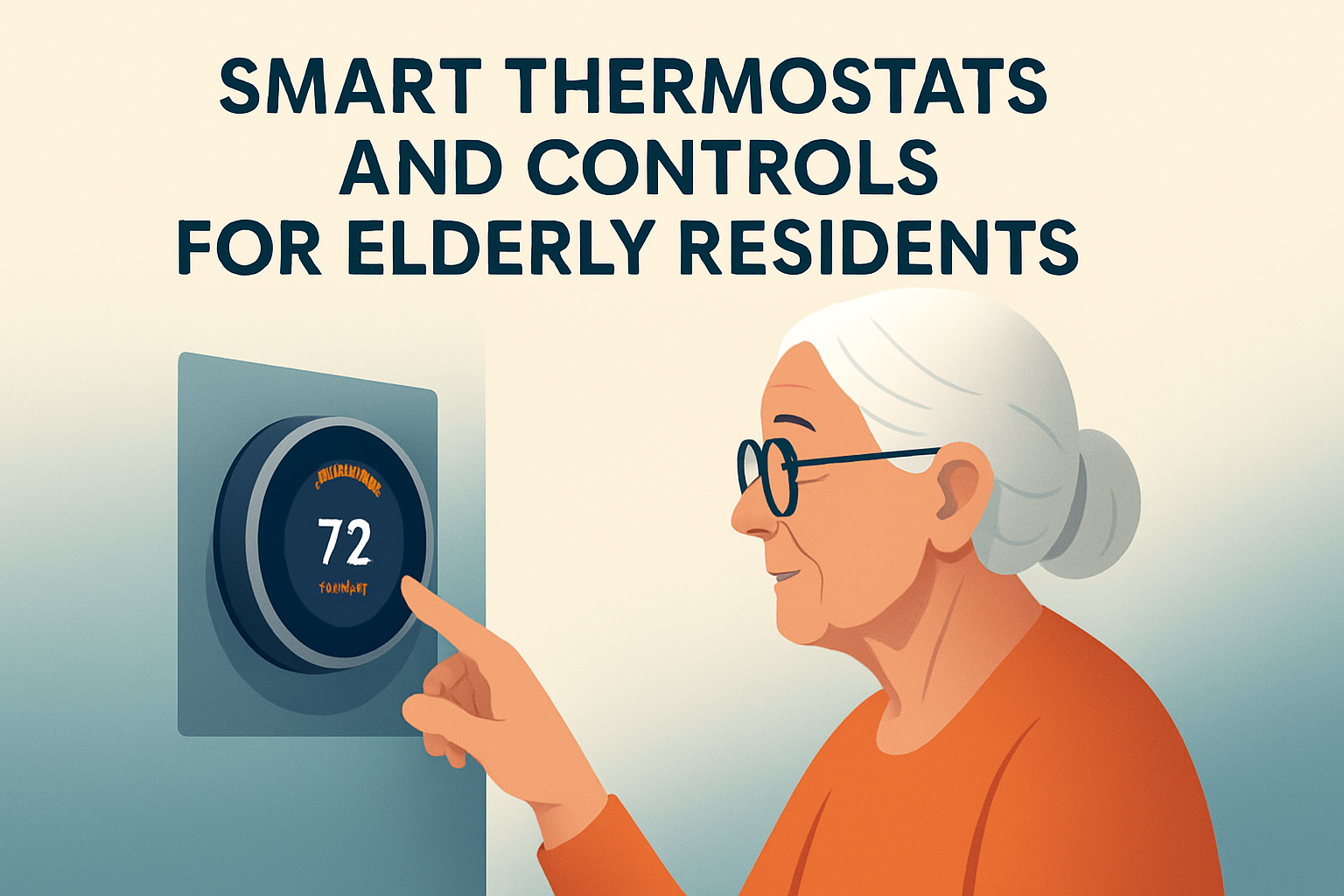
Smart thermostats and controls for elderly residents make home comfort safer, simpler, and more reliable by combining automatic climate management with accessible interfaces, remote support, and integration across the wider smart home. In practical terms, a smart thermostat is a connected device that learns schedules, senses occupancy, adjusts heating and cooling automatically, and can be controlled by app, voice assistant, wall display, or caregiver dashboard. Smart controls extend that idea beyond one thermostat to include room sensors, smart vents, humidifiers, heat pump settings, boiler timing, air quality monitors, and automations that coordinate temperature with lighting, locks, alerts, and energy use. For older adults, that matters because temperature is not merely a comfort issue. Aging changes how the body senses heat and cold, chronic conditions can increase sensitivity to temperature swings, and medication can affect hydration and thermoregulation. I have seen families focus on fall prevention while overlooking the role indoor climate plays in sleep quality, respiratory comfort, cognition, and general safety. A house that becomes too cold overnight or too warm during a summer outage can quickly become a health risk. A well-designed smart home integration strategy helps reduce those risks while supporting independence, especially for seniors aging in place, living alone, or receiving periodic help from family and professional carers.
The strongest systems are not built around gadgets. They are built around accessibility, predictability, and backup options. That means selecting controls with large readable displays, high-contrast screens, clear physical buttons, and voice commands that work without complex menus. It also means deciding who can access the system, how alerts are sent, what happens if Wi-Fi fails, and whether the heating and cooling equipment itself is compatible. This hub article covers smart home integration for climate control from the ground up: device types, accessibility features, installation choices, voice and app control, caregiver access, safety routines, energy management, and evaluation criteria. It is designed to help readers understand the full landscape before choosing a specific thermostat, HVAC platform, or connected ecosystem. If you are comparing solutions for an older parent, planning an accessible retrofit, or coordinating climate control with other accessibility and mobility solutions, this guide explains what to prioritize and why.
What Smart Home Integration Means for Senior Climate Control
Smart home integration for heating and cooling means the thermostat does not operate in isolation. It communicates with sensors, HVAC equipment, mobile apps, voice assistants, and sometimes emergency notifications so indoor conditions stay stable with less manual effort. In homes for elderly residents, integration should solve concrete problems: forgetting to adjust settings, difficulty reading a small screen, uneven temperatures between rooms, doors left open, unsafe heat during summer, and unnecessary utility costs on fixed incomes.
Most modern platforms fall into a few categories. There are mainstream consumer thermostats such as Google Nest Learning Thermostat, ecobee Smart Thermostat Premium, Amazon Smart Thermostat, and Honeywell Home T9 or T10 Pro. There are also contractor-focused controls from brands like Carrier, Trane, Lennox, and Bosch that tie more directly into variable-speed systems, zoning panels, or heat pumps. In apartments and assisted living settings, simple programmable thermostats with remote visibility may be more appropriate than learning models, because consistency matters more than algorithmic adaptation. In larger homes, room sensors can correct the common problem of one central hallway thermostat misrepresenting actual comfort where the resident sleeps or spends most of the day.
Good integration also supports interoperability. Matter, Thread, Wi-Fi, Zigbee, and Z-Wave can all play a role, but protocol choice should follow reliability and support rather than trend. In my experience, families are happiest when the thermostat can be controlled locally at the wall, remotely by approved contacts, and verbally through a familiar assistant such as Alexa or Google Assistant. If one control method fails, another remains available. That redundancy is essential for older adults who may not want to rely exclusively on smartphones.
Accessibility Features That Actually Help Older Adults
The best thermostat for an elderly resident is rarely the one with the most features. It is the one the resident can understand and use confidently every day. Start with visibility. A large backlit display, bold numerals, strong contrast, and plain language labels are more useful than minimalist design. Touchscreens can be excellent when icons are large and response is consistent, but many older adults still prefer tactile buttons or a rotating dial because they provide physical feedback. That is why products from Honeywell Home and ecobee often work well in accessible retrofits: their interfaces are more explicit than many ultra-minimal options.
Hearing and speech considerations matter too. Voice control can be transformative for residents with arthritis, reduced mobility, or low vision, but command structures must be simple. “Set the temperature to 72 degrees” is easier to remember than navigating a nested app menu. At the same time, voice should not be the only access method, because speech recognition may struggle with accent, background noise, or certain medical conditions. The system should confirm commands audibly and visibly.
Cognitive load is another major issue. Older residents with mild cognitive impairment often do better with limited choices and stable routines. Instead of exposing every HVAC mode, create simple presets such as Home, Sleep, Away, and Heat Alert. Lock advanced settings behind caregiver access. Some thermostats allow temperature range limits, preventing accidental settings like 85 degrees in summer or 60 degrees in winter. That single feature can prevent discomfort, excessive bills, and dangerous indoor conditions.
Accessibility also includes maintenance. Battery alerts should be obvious, filter reminders should be automated, and app notifications should go to someone responsible for follow-up. If the resident is unlikely to notice a “replace filter” message, remote oversight becomes part of accessibility, not a luxury add-on.
Core Components of a Senior-Friendly Smart Climate Setup
A complete setup usually includes more than a thermostat on the wall. The right combination depends on the home, the resident’s health, and the HVAC equipment already installed.
| Component | What it does | Why it helps elderly residents |
|---|---|---|
| Smart thermostat | Controls heating and cooling schedules, setpoints, and modes | Reduces manual adjustments and enables remote support |
| Room sensors | Measure temperature and occupancy in key spaces | Keeps bedroom or living room comfortable instead of relying on hallway readings |
| Voice assistant | Accepts spoken temperature commands and routines | Helps residents with mobility limits or poor vision |
| Caregiver app access | Lets trusted contacts view status and adjust settings | Allows quick intervention during heat waves, cold snaps, or confusion |
| Air quality or humidity monitor | Tracks humidity, particulates, or ventilation conditions | Supports respiratory comfort and helps avoid overly dry or damp air |
| Smart plugs or connected fans | Runs supplemental devices during temperature events | Adds local comfort without complex manual steps |
| Leak, smoke, or outage alerts | Notifies household or family when home conditions change | Improves safety when climate events coincide with other household risks |
When these components work together, the home becomes easier to manage. For example, a room sensor in the bedroom can prioritize nighttime comfort, while a caregiver receives a push notification if indoor temperature rises above a chosen threshold. A connected fan can switch on during a warm afternoon, and shades can close automatically if the ecosystem supports it. This is where smart home integration becomes valuable as a hub topic: climate control is one layer in a broader accessibility strategy that may also include smart lighting, video doorbells, medication reminders, and mobility-focused automation.
Installation, Compatibility, and Professional Assessment
Before buying anything, verify compatibility with the HVAC system. This step prevents many failed installations. Some thermostats need a C-wire for continuous power. Others support power extender kits, but those are not ideal in every setup. Heat pumps, multi-stage furnaces, dual-fuel systems, electric baseboard heating, radiant systems, mini-splits, and boiler controls each have different requirements. A thermostat that works perfectly with a standard single-stage forced-air furnace may not support humidification control, dehumidification, or variable-speed compressor logic in a more advanced system.
I strongly recommend a professional assessment when the resident depends on stable indoor conditions or when the home uses older equipment. An HVAC technician or qualified smart home installer can identify wiring limits, zoning constraints, poor sensor placement, duct issues, and oversizing or undersizing problems that no thermostat can solve by itself. In several homes I have assessed, the “smart thermostat problem” turned out to be a return-air imbalance, dirty filter, failing capacitor, or thermostat mounted on a drafty wall. Integration works best after the underlying heating and cooling system is functioning properly.
Placement matters as much as wiring. Thermostats should be away from direct sunlight, kitchens, fireplaces, exterior doors, and supply vents that distort temperature readings. If the resident spends most of the day in a back room or addition, sensor placement becomes especially important. The goal is not technically accurate average temperature. The goal is perceived comfort where the person actually lives.
Voice Control, Apps, and Remote Family Support
Remote support is one of the biggest advantages of smart thermostats for elderly residents. Adult children can verify that the home is not overheating during a July heat wave, check whether the furnace recovered after a power interruption, or switch the system to a safer setting when a parent is confused by a control screen. This type of support should be set up intentionally. Use shared access accounts with clear permissions, document the preferred temperature ranges, and decide who receives alerts. If multiple relatives have control without coordination, settings can become inconsistent and frustrating.
Voice assistants add another layer of convenience. Alexa, Google Assistant, and Apple Home can all support thermostat commands, but setup quality matters more than brand loyalty. Use routine names that match natural speech. Keep microphones close enough to hear the resident from bed or favorite chair. Disable unnecessary notifications. Test commands under real conditions, including TV noise and weak speech. For privacy, explain what data is collected, whether recordings are stored, and how to review or delete them. Trust is critical when installing always-listening devices in a senior’s home.
Apps should be simple, not exhaustive. The ideal caregiver dashboard shows current temperature, humidity, mode, schedule, and alerts at a glance. Geofencing can be useful for active older adults, but it is less appropriate if the resident rarely carries a smartphone. In those cases, a fixed schedule with room sensors is more dependable than occupancy logic.
Safety, Health, and Emergency Planning
Temperature control intersects directly with health. Older adults are at greater risk during extreme heat and cold, and indoor conditions can become dangerous before anyone notices. Smart controls help by maintaining tighter temperature ranges, sending alerts, and automating responses. During heat waves, for example, a system can pre-cool the house before peak afternoon load, lower blinds through connected shade controls, and notify family if indoor temperature exceeds a threshold such as 80 degrees. During winter, freeze alerts can warn that heating has failed before pipes burst and before the resident experiences prolonged cold exposure.
Humidity deserves equal attention. Air that is too dry can worsen irritation, while excess humidity supports mold growth and can intensify discomfort. ASHRAE guidance is often used to frame healthy indoor conditions, and many homes perform best when relative humidity stays in a moderate range rather than swinging widely. Smart thermostats with humidity sensing, or companion indoor air monitors, make those trends visible.
Emergency planning should include outages and internet failure. If power goes out, does the system recover to the correct schedule automatically? Can the resident still operate the thermostat manually? Does someone receive an alert if the home goes offline? Battery backup for internet equipment may extend notifications for a short period, but it does not power the HVAC system itself. In regions with serious heat or cold events, backup heating, cooling, or relocation plans remain necessary. Smart controls improve resilience, but they do not replace emergency preparedness.
Energy Savings Without Sacrificing Comfort
Energy efficiency matters for many seniors because utility bills compete with medication, food, transportation, and care costs. Smart thermostats can lower costs through scheduling, occupancy setbacks, demand response participation, and more precise control, but savings vary widely. U.S. Department of Energy guidance on programmable setbacks remains relevant: lowering heating setpoints for several hours or raising cooling setpoints when appropriate can reduce energy use. However, savings should never come at the expense of health. For frail residents, aggressive setbacks may create discomfort or risk, especially overnight or during extreme weather.
In practice, modest and consistent settings work best. A home might be kept at 70 degrees during occupied winter hours, 67 for sleep, and 65 only when the resident is away for a substantial period. Cooling may stay at 76 to 78 when occupied, adjusted for medical needs and humidity. Room sensors often improve comfort enough that the central setpoint can be slightly more efficient without making the resident feel colder or warmer. Maintenance also drives savings. Clean filters, sealed ducts, proper refrigerant charge, and insulated attics often deliver more benefit than fancy automation alone.
Utility rebate programs can offset equipment cost. Many electric and gas utilities offer incentives for qualified smart thermostats, especially models that support demand response. Check the terms carefully, because some programs allow temporary utility adjustments during peak events. For elderly residents with health vulnerabilities, opt out if those events could create unsafe indoor conditions.
How to Choose the Right System for This Subtopic Hub
As the hub page for smart home integration under accessibility and mobility solutions, this topic should guide readers toward a decision framework rather than a one-size-fits-all product list. Start with the resident profile: mobility limitations, vision, hearing, cognition, tech confidence, and health conditions that affect temperature sensitivity. Next, map the home: HVAC type, number of floors, hot and cold spots, internet reliability, and whether family members need remote access. Then define priorities in order: safety, simplicity, comfort, support, and efficiency.
For many households, the best choice is a thermostat with an accessible wall interface, reliable app, room sensors, and optional voice control. For more complex homes, professional zoning and contractor-grade controls may be justified. For renters or budget-sensitive households, a straightforward Wi-Fi thermostat with caregiver access may cover the essentials. What matters is not buying the most advanced system. It is building a climate control setup the resident will actually trust and use.
The broader smart home roadmap should connect this page to related articles on voice assistants, fall detection, smart lighting, door and entry controls, air quality monitoring, home security, and power outage planning. Climate control sits at the center because comfort, safety, and independence all depend on it. Choose systems with accessible controls, tested compatibility, meaningful alerts, and clear backup options. Then review settings with the resident, train family supporters, and schedule a seasonal checkup. Smart thermostats and controls for elderly residents deliver their real value when they quietly make daily living easier, safer, and more dignified. Start with one dependable upgrade, then expand the integration around actual needs.
Frequently Asked Questions
What are smart thermostats and controls, and how do they help elderly residents?
Smart thermostats are connected temperature-control devices that do much more than simply turn heating or cooling on and off. They can learn daily routines, detect whether someone is home, adjust settings automatically, and allow temperature changes through a wall unit, smartphone app, voice assistant, or remote caregiver access. Smart controls expand this concept by linking the thermostat to other devices and systems in the home, such as room sensors, smart vents, humidity monitors, air-quality sensors, window and door sensors, and home automation platforms. Together, these tools create a more responsive and easier-to-manage comfort system.
For elderly residents, the value is not just convenience. It is safety, consistency, and reduced effort. Older adults may be more sensitive to temperature extremes, may forget to adjust settings, or may find traditional thermostats difficult to read or program. A smart thermostat can maintain a stable indoor environment automatically, reducing the likelihood of rooms becoming too cold in winter or too hot in summer. It can also minimize the need to walk across the house to adjust settings, which may be especially important for people with mobility limitations, arthritis, vision changes, or balance concerns.
These systems can also support independence. Rather than relying on constant in-person help, an elderly resident can use simple voice commands, large on-screen controls, or preset comfort schedules. Family members or caregivers, when given permission, can monitor and adjust settings remotely if needed. This makes it easier to respond quickly during weather changes, illness, or periods of reduced mobility. In short, smart thermostats and controls help elderly residents stay more comfortable while making the home environment safer, simpler, and more reliable.
Are smart thermostats easy for seniors to use?
Many smart thermostats are specifically well suited to seniors when chosen carefully, but ease of use depends on the model, setup, and interface options. The best systems for elderly residents are those that offer multiple ways to control the temperature. Some people prefer a simple wall-mounted touchscreen with large numbers and clear labels. Others find voice control easier because it removes the need to navigate menus or use a small device. Still others are comfortable with an app, especially if family members can help with setup and ongoing support.
A well-designed smart thermostat can actually be easier to use than a traditional programmable thermostat. Conventional thermostats often require confusing button combinations, small displays, and complex programming steps. By contrast, many smart models simplify common tasks such as setting a preferred daytime temperature, creating a sleep schedule, or temporarily raising the heat. Some systems can automatically handle these changes after the initial setup, which means the resident does not have to interact with the thermostat often at all.
That said, not every product is equally senior-friendly. Features to look for include large, high-contrast displays, plain-language menus, intuitive controls, audible confirmations, voice assistant compatibility, and the ability to lock or simplify advanced settings. It is also helpful if the system supports caregiver dashboards or shared app access, so a trusted family member can troubleshoot remotely without requiring the resident to manage technical details. The key is to choose a system that matches the person’s comfort level with technology rather than assuming every smart device will automatically be easy to use.
Can family members or caregivers control a smart thermostat remotely?
Yes, remote access is one of the most useful features of smart thermostats and controls for elderly residents. Most connected systems allow authorized users to view and adjust the home’s temperature through a secure app or online dashboard. This means a family member, caregiver, or home support provider can help manage comfort settings without needing to be physically present in the house. For example, they can warm the home before the resident wakes up, lower the cooling bill when the house is empty, or respond quickly if indoor temperatures become unsafe during extreme weather.
Remote support can be especially valuable when an older adult is recovering from illness, has memory challenges, or is less comfortable using digital tools. Instead of trying to explain thermostat settings over the phone, a caregiver can log in and make the changes directly. Some systems also provide alerts for unusually high or low temperatures, connectivity issues, or HVAC performance concerns. These notifications can help family members recognize a potential problem before it becomes a serious comfort or health issue.
Privacy and security should always be part of the setup process. Access should be limited to trusted individuals, and account permissions should be managed carefully. In some homes, it makes sense to give a caregiver full control while giving other family members view-only access. The goal is to support the resident without undermining their independence. When configured thoughtfully, remote control offers peace of mind for everyone involved while helping ensure the home stays consistently safe and comfortable.
Do smart thermostats improve safety and energy efficiency for older adults?
In many cases, yes. Smart thermostats can improve safety by reducing exposure to uncomfortable or potentially risky indoor temperatures. Elderly residents may be more vulnerable to heat stress, cold-related discomfort, dehydration, or complications from poorly regulated indoor environments. A smart thermostat can automatically maintain temperature within a more appropriate range, even if the resident forgets to make adjustments. Some systems can also use alerts, schedules, and occupancy detection to keep the environment stable throughout the day and night.
Safety can also improve through reduced physical strain. If a resident no longer needs to walk to a thermostat repeatedly, reach up to read a small screen, or manually change settings several times a day, there is less physical effort involved in managing comfort. Voice commands and remote support may further reduce frustration and mobility-related challenges. In homes with integrated smart controls, sensors can help identify room-by-room comfort problems, which is especially useful if one area of the house becomes too warm or too cold for safe use.
On the efficiency side, smart thermostats are designed to avoid unnecessary heating and cooling. They can learn routines, reduce HVAC use when no one is home, and optimize schedules based on real-world occupancy and seasonal patterns. This can lower utility bills while still protecting comfort. For older adults on a fixed income, that cost control can be a meaningful benefit. Efficiency, however, should never come at the expense of health and comfort. The best setup is one that balances savings with dependable temperature stability, especially during overnight hours and extreme outdoor conditions.
What should you look for when choosing a smart thermostat for an elderly resident?
The most important factor is usability. A smart thermostat for an elderly resident should fit the person’s physical needs, cognitive comfort level, and daily routine. Look for a model with a bright, easy-to-read display, simple temperature controls, and a straightforward interface that does not overwhelm the user with technical options. If the resident has vision limitations, high-contrast screens and large numerals are especially important. If hand dexterity is a concern, responsive touch controls or voice integration may be a better choice than small buttons.
Compatibility is another major consideration. The thermostat should work with the home’s existing heating and cooling system, whether that is forced air, a heat pump, radiant heating, zoned HVAC, or another setup. It is also worth considering whether the device supports additional smart controls such as room sensors, humidity tracking, air-quality monitoring, and integration with voice assistants or other smart home platforms. These added features can make the system more helpful over time, particularly if the resident’s needs change.
Support features matter as well. Many families benefit from systems that allow secure remote access, maintenance alerts, and easy app sharing for caregivers. Reliable customer support, professional installation options, and clear documentation can also make a big difference. Finally, think beyond features and focus on outcomes: the right thermostat should make the home easier to live in, not more complicated. A good choice is one that quietly keeps temperatures comfortable, allows trusted helpers to assist when needed, and gives the resident more confidence and independence in daily life.