Choosing which stair lift is best for people with MS starts with understanding that multiple sclerosis affects mobility in unpredictable ways, so the safest and most comfortable lift is the one that matches current symptoms while accommodating likely changes over time. In my work reviewing home accessibility equipment and speaking with installers, occupational therapists, and families, I have seen one pattern repeatedly: buyers often focus on brand names first, when they should begin with disease progression, transfer ability, seat support, and staircase design. MS can cause leg weakness, spasticity, fatigue, numbness, balance loss, visual changes, and heat sensitivity. Those factors make stairs risky even for people who can still walk short distances on level ground.
A stair lift, sometimes called a chair lift for stairs, is a motorized seat that travels along a rail fixed to the staircase treads. It is not the same as a vertical platform lift or a home elevator. For many disabled users, and especially for people with MS, a stair lift is the most practical middle ground between doing nothing and undertaking a major remodeling project. It reduces fall risk, preserves access to bedrooms and bathrooms, and can delay or prevent an expensive move. The best models also support caregivers by reducing the physical strain of assisting on the stairs.
This guide serves as a hub for best chair lifts for disabled users, with a specific focus on MS. It covers what features matter most, when a straight stair lift is enough, when a curved model is necessary, and when a perch seat, heavy-duty unit, or platform lift may be the better fit. It also explains the real tradeoffs around price, maintenance, installation timelines, and long-term usability. If you are comparing stair lift brands, requesting quotes, or planning for future progression, this article will help you ask the right questions and narrow the field to the options that genuinely fit daily life with MS.
What People with MS Need Most From a Stair Lift
The best stair lift for a person with MS is usually the one that minimizes transfers, supports posture, and remains easy to operate on low-energy days. That sounds simple, but it leads to very specific requirements. First, seat stability matters more than many buyers expect. People with trunk weakness or poor balance often do better with a firm, well-contoured seat, supportive armrests, and a seat belt that is easy to fasten with limited hand dexterity. I advise clients to test the swivel seat carefully because getting on and off at the top landing is where many near-falls happen.
Second, smooth starts and stops are essential. MS symptoms can be aggravated by sudden motion, and jerky travel can feel unsafe for users with spasticity or vestibular issues. Reputable brands such as Bruno, Stannah, Handicare, Harmar, and Access BDD design their lifts with soft-start and soft-stop systems, but ride quality still varies by model and by installation quality. A well-installed rail with proper gearing should feel controlled, not abrupt.
Third, controls must match hand function and cognition. Toggle controls, rocker switches, and large call-send remotes are usually easier than small buttons. If numbness, tremor, or weakness affects grip, ask whether the arm control requires sustained pressure or just a light hold. Some users with cognitive fatigue prefer the simplest possible interface with minimal extra features.
Fourth, battery backup is nonnegotiable. Most modern stair lifts run on battery power and charge continuously at designated points, allowing operation during power outages. For users with MS, that is not a convenience feature; it is a safety requirement. If a storm knocks out electricity and the only accessible bathroom is upstairs, the lift must still work.
Best Types of Stair Lifts for MS: Straight, Curved, Perch, and Platform
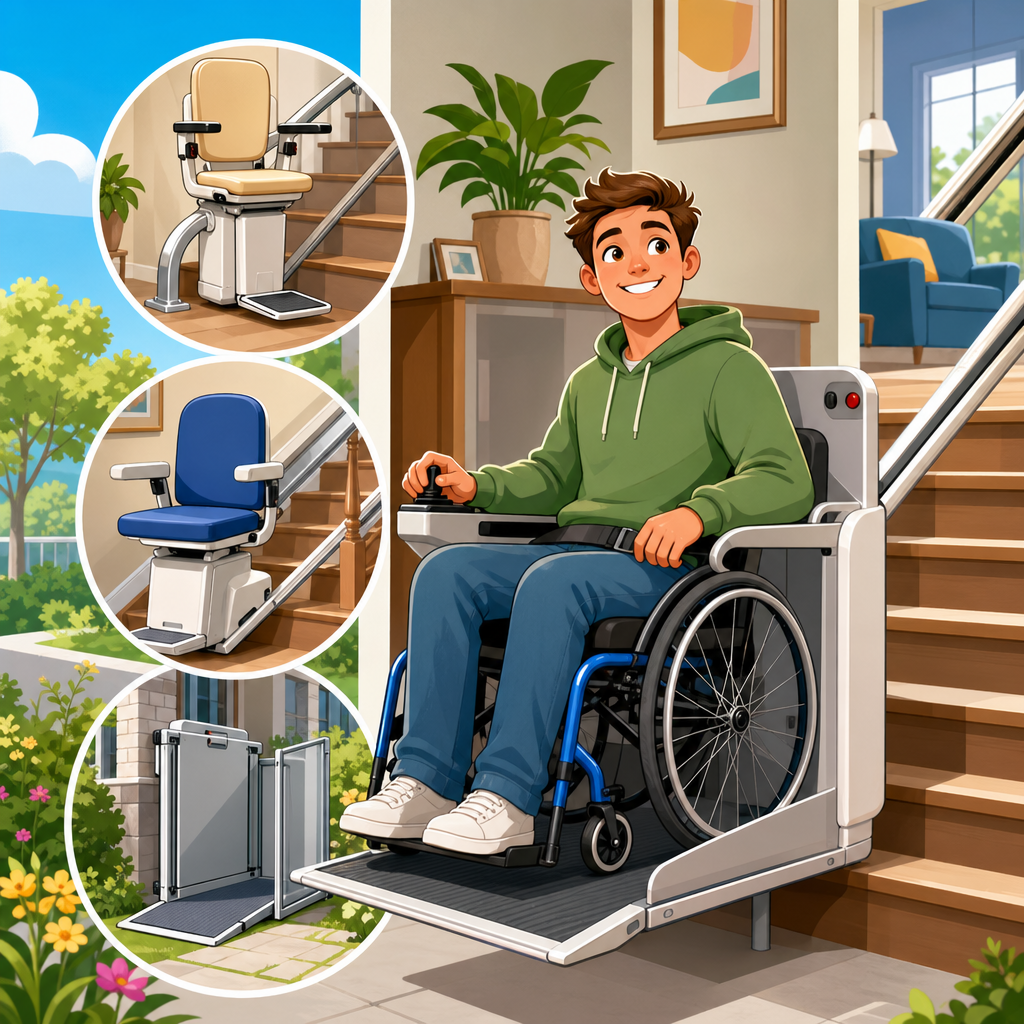
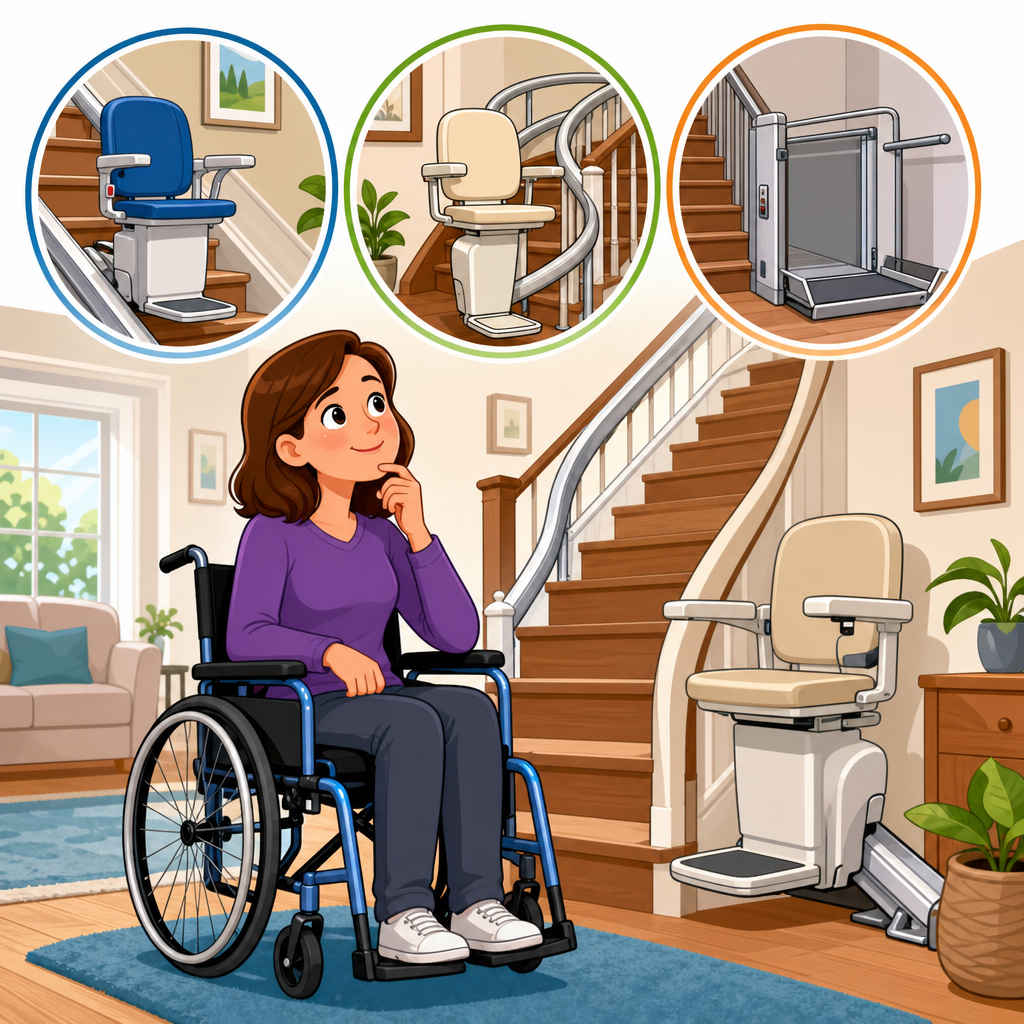
There is no single best chair lift for disabled users because staircases and bodies vary. The correct category depends on the home layout and the user’s functional profile. Straight stair lifts are the most common and most affordable. They fit staircases with no turns, intermediate landings, or directional changes. If the stairs run in one uninterrupted line, a straight lift from Bruno Elan, Harmar SL300, or Stannah Sadler equivalent configurations may be the most cost-effective choice. Installation is also faster because the rail is usually cut to length from stock.
Curved stair lifts are required for stairs with turns, pie-shaped treads, or split landings. These lifts use a custom-built rail based on detailed measurements or digital scanning. They cost substantially more, but for many two-story homes they are the only realistic option. Models such as the Bruno Elite Curved and Handicare Freecurve are often shortlisted because they can navigate tighter turns while maintaining a comfortable seat position. For people with MS, the advantage of a curved lift is simple: one continuous trip is safer than transferring to walk across a landing and then boarding a second lift.
Perch stair lifts deserve serious consideration when knee or hip flexion is limited, or when the staircase is very narrow. Instead of sitting fully, the user leans against a higher seat in a semi-standing posture. Some people with MS who struggle to rise from low chairs find perch designs easier. Others dislike them because they require more balance and trunk control. They are useful only when the individual can tolerate that posture consistently.
Platform lifts are often a better answer when a wheelchair user cannot transfer safely to a seat. They carry the wheelchair itself, but they take up more space, cost more, and usually involve stricter code considerations. In my experience, families sometimes try to force a chair lift solution when transfer ability has already declined too far. At that point, a platform lift or elevator may be the safer long-term investment.
Features That Separate an Average Lift From the Right Lift
When evaluating the best stair lift for MS, focus on features that affect daily use rather than showroom appeal. Seat height is a major factor. A seat that is too low makes standing difficult for users with quadriceps weakness. Adjustable seat height, higher seat bases, or perch-style options can make a meaningful difference. Weight capacity also matters. Standard stair lifts often support around 275 to 350 pounds, while heavy-duty models can exceed 400 pounds and usually provide wider seats.
Rail overrun is another feature that deserves attention. A hinged rail or track overrun moves the boarding point away from the staircase edge, reducing the chance of a fall at the top or bottom landing. For users with visual changes, dizziness, or poor foot placement, that added margin of safety is valuable. Powered swivel seats are also worth discussing. Manual swivels are common, but a powered swivel can help users who have difficulty twisting their torso or releasing a lever.
Footrest design is often overlooked. People with MS may drag a foot, have reduced proprioception, or wear orthotics. A roomy footrest with obstruction sensors is important, and a powered folding footrest can help if bending is difficult. Upholstery should be firm and easy to clean, not so padded that transfers become unstable. Finally, ask about diagnostic systems and service support. A lift with simple onboard fault codes is easier to troubleshoot quickly.
| Need | Helpful Feature | Why It Matters for MS |
|---|---|---|
| Leg weakness | Higher seat height or perch option | Reduces effort needed to stand up safely |
| Poor balance | Powered swivel and rail overrun | Creates a safer transfer zone at landings |
| Hand numbness | Large rocker control | Easier to operate than small buttons |
| Fatigue | Smooth ride and simple controls | Lowers physical and cognitive strain |
| Future progression | Wider seat and higher capacity model | Provides more flexibility as needs change |
Top Stair Lift Brands and Models Often Recommended
If you are asking which stair lift brand is best for people with MS, the honest answer is that the best brand is usually the one with the right local dealer and service network. A strong model installed badly is still a bad outcome. That said, a few manufacturers consistently appear in serious comparisons. Bruno is known for sturdy construction, straightforward controls, and strong dealer support in the United States. The Bruno Elan is a widely recommended straight stair lift, while the Bruno Elite line offers a more premium ride and larger seat options.
Stannah has a long track record and is often praised for ride quality and customization, especially on curved stairs. Handicare is frequently chosen for narrow staircases and complex layouts, with models such as the Freecurve and 1100 designed to fit tighter spaces. Harmar remains a major name in the U.S. market, offering several straight stair lift options and heavy-duty configurations. Access BDD is another manufacturer often supplied through dealers, particularly where compact installations are needed.
For disabled users broadly, and MS users specifically, I would rank dealer quality, after-sales service, and fit to symptoms above small differences in styling. Ask how quickly repairs are handled, whether technicians carry common parts, and what preventive maintenance schedule is recommended. A stair lift is only as good as its reliability on the day the user needs it most.
How to Match the Lift to the Person, Not Just the Staircase
The buying mistake I see most often is selecting a lift solely by measuring the stairs. The right process starts with the user. Can the person transfer independently? Can they pivot safely? Do they need supervision at the top landing? Are symptoms worse in the evening? Is there enough trunk stability for a perch seat? Could progression make transfers unsafe within a year or two? These questions matter as much as the rail shape.
An occupational therapist can be extremely helpful during this stage. A home assessment may identify issues buyers overlook, such as poor lighting, lack of grab bars near the landing, carpet thickness affecting foot placement, or fatigue patterns that influence safe use. For MS, timing matters too. A user may manage stairs in the morning but become unsafe after work or after heat exposure. The lift should be chosen for the person’s worst reliable day, not their best day.
Think about caregiver involvement as well. If a spouse may need to assist with transfers, seat width, armrest position, and landing clearance become more important. If the user commonly carries medical supplies or uses a cane, determine where those items will go during travel. Good stair lift planning is not just equipment selection; it is workflow design for everyday living.
Costs, Installation, and Practical Buying Advice
Price varies widely, and MS buyers should budget for the whole project, not just the base unit. Straight stair lifts commonly start around the low thousands installed, while curved lifts can run several times higher because the rail is custom fabricated. Heavy-duty seats, powered options, hinged rails, and extended warranties increase cost. Used or reconditioned straight stair lifts can be a smart option when supplied by a reputable dealer, but used curved rails rarely fit another staircase.
Medicare typically does not cover stair lifts because they are usually classified as home modifications rather than durable medical equipment for reimbursement purposes, although local programs, Medicaid waivers, veterans’ benefits, nonprofit grants, or state assistive technology programs may help in some cases. This varies by location, so buyers should ask both the dealer and a local aging or disability resource center about funding pathways.
Before signing, request an in-home assessment, a written quote, warranty details, expected installation time, service response policy, and a clear explanation of return terms. Confirm whether the rail attaches to the stair treads rather than the wall, because many buyers worry unnecessarily about wall damage. Also ask about seat depth, folded width, and whether others can still use the stairs comfortably.
When a Stair Lift Is Not the Best Option
A stair lift is not always the best answer for a person with MS, and acknowledging that is part of making a safe decision. If the user cannot transfer onto the seat without substantial lifting, if they slide in the chair, or if trunk control is too poor to stay centered even with a belt, a platform lift or home elevator may be more appropriate. The same applies when wheelchair dependence is likely soon and the family wants to avoid replacing the solution twice.
There are home layouts where moving a bedroom downstairs is cheaper and safer than installing a complex curved rail. In other cases, adding a second bathroom on the main level removes the immediate need for stair travel entirely. I have also seen buyers benefit from combining a stair lift with additional modifications such as contrasting stair-edge tape, landing grab bars, improved lighting, and heat management strategies that reduce fatigue before transfers.
The key is to view the stair lift as one part of an accessibility plan. The best equipment choice is the one that improves safety today and still makes sense if symptoms change.
For people living with MS, the best stair lift is usually a battery-powered model with a smooth ride, secure seat, easy controls, safe landing access, and enough flexibility to handle progression in mobility. Straight lifts are ideal for simple staircases and tighter budgets. Curved lifts are worth the extra cost when they eliminate risky transfers across turns and landings. Perch lifts help some users with difficult sit-to-stand movement, while platform lifts are better when wheelchair transfers are no longer safe.
The most important buying principle is to match the lift to the person first and the staircase second. Evaluate transfer ability, fatigue, balance, hand function, and likely future needs. Then compare brands based on dealer quality, service response, and real fit rather than marketing claims. An in-home assessment, ideally with input from an occupational therapist, will usually reveal the right direction faster than online specs alone.
If you are researching the best chair lifts for disabled users, use this guide as your starting hub and build your shortlist around safety, comfort, and long-term usability. Get two or three detailed quotes, ask hard questions about service, and insist on a live demonstration before you buy.
Frequently Asked Questions
What type of stair lift is usually best for someone with multiple sclerosis?
The best stair lift for a person with MS is usually the one that matches their current balance, strength, fatigue level, and transfer ability while also leaving room for future changes. In many cases, a standard seated stair lift works well for someone who can still sit down and stand up safely with support. However, if MS symptoms include significant leg weakness, poor trunk control, tremors, or difficulty pivoting into a seat, a more supportive model with a higher backrest, swivel seat, seatbelt, and easy-to-use controls may be a better fit. For some users, a perch-style lift can help if bending the knees to sit is difficult, but this is only appropriate when the person can ride safely in a more upright position. If the staircase is curved, narrow, or has intermediate landings, a custom curved stair lift may be necessary rather than a straight model.
What matters most is not the brand name but how the lift matches the person’s symptoms and how those symptoms may change. MS can be unpredictable. Someone who manages well with a basic seated lift today may later need powered swivel assistance, a folding rail, or easier transfer space at the top and bottom of the stairs. That is why the safest approach is to think beyond the immediate need and choose a model that supports comfort, stability, and long-term usability. A professional home assessment from a stair lift installer, ideally combined with input from an occupational therapist, is often the best way to determine which type is truly most appropriate.
Which stair lift features are most important for people with MS?
For people with MS, the most important stair lift features are usually those that improve safety, reduce physical effort, and make everyday use less fatiguing. A powered swivel seat is one of the most valuable upgrades because it helps the user turn safely toward the landing without twisting the body during transfers. A seatbelt is essential, and a secure footrest matters because it helps keep the feet stable, especially for users with spasms, weakness, or reduced coordination. Easy-touch controls on the armrest and remote call/send controls are also important, since hand weakness or fatigue can make small buttons or stiff joysticks harder to manage.
Other features can be just as important depending on the individual. A higher seat height may make standing easier for someone with weak legs. A larger seat or extra padding can improve comfort if the user spends a lot of time sitting throughout the day. Folding arms, seat, and footrest help preserve stair access for others in the home, while obstruction sensors add an extra layer of safety. Battery backup is especially important, because a person with MS may not be able to manage the stairs at all during a power outage. In short, the best features are the ones that reduce strain and support consistency, not just the ones that sound impressive in a brochure.
Should someone with MS choose a stair lift based on current symptoms or future progression?
In most cases, the right decision is to consider both. It is perfectly reasonable to choose a stair lift that works well for current needs, but it is a mistake to ignore the possibility that MS symptoms may change over time. The course of multiple sclerosis varies widely. Some people remain relatively stable for years, while others experience worsening fatigue, reduced leg strength, more pronounced spasticity, or increasing difficulty with transfers. Because of that unpredictability, the best stair lift is often one that solves today’s mobility problem without creating unnecessary limitations a year or two from now.
That does not always mean buying the most complex or expensive model available. It means asking practical questions during the selection process. Can the user get on and off the seat safely on both good days and bad days? Will the controls still be manageable if hand dexterity declines? Is there enough space at the landing for a caregiver to assist if needed later? Can powered features be added now or included from the start to avoid replacing the lift sooner than expected? Thinking this way helps families avoid focusing too narrowly on cost or brand reputation and instead choose a system that remains safe and realistic as needs evolve.
Are stair lifts safe for people with MS who have fatigue, weakness, or balance problems?
Yes, stair lifts can be very safe for people with MS, and for many households they are far safer than continuing to use the stairs independently. MS-related fatigue, leg weakness, dizziness, poor coordination, and balance problems all increase the risk of falling on stairs, especially later in the day when symptoms may be worse. A properly selected and properly installed stair lift reduces that risk by removing the need to climb the staircase manually. Modern lifts also include important safety features such as seatbelts, footrest sensors, obstruction detection, swivel locks, and battery-powered operation during outages.
That said, overall safety depends on fit and setup. A stair lift is only as safe as the user’s ability to transfer onto and off the seat. If someone has severe balance issues, difficulty remaining upright while seated, or unpredictable spasms, those factors need to be evaluated carefully. Sometimes the safest solution includes not just the lift itself but also grab bars, a transfer aid, better lighting, or caregiver assistance at one or both landings. This is why a thoughtful assessment matters so much. When the equipment matches the person’s abilities and the home layout, a stair lift can be an excellent safety tool for managing stairs with MS.
How can families choose the best stair lift company or installer for someone with MS?
Choosing the right company is almost as important as choosing the right lift. Families should look for an installer that starts with a detailed assessment of the user’s mobility rather than jumping straight into a sales pitch about brands or discounts. A good company will ask how the person with MS transfers, whether symptoms fluctuate, if fatigue is a major issue, whether there is a caregiver involved, and what concerns exist about future progression. They should also measure the staircase carefully, explain whether a straight or curved rail is needed, and discuss landing safety in practical terms. Installers who have experience with disability access and who are comfortable coordinating with occupational therapists are often a strong choice.
It also helps to ask about service after installation. Stair lifts are long-term mobility devices, so reliability, maintenance support, warranty coverage, and response time for repairs matter a great deal. Families should ask whether the company services the equipment locally, how quickly emergency calls are handled, and whether replacement parts are readily available. Reviews can be useful, but the best sign of quality is often how carefully the company evaluates the user’s real-world needs. For someone with MS, the best installer is not the one with the loudest marketing. It is the one that treats the purchase as a personalized accessibility solution and takes the time to make sure the lift will remain safe, comfortable, and practical over time.