When families ask, “How much do chair lifts cost?” they are usually comparing more than a product price. They are weighing safety, home layout, long-term mobility, maintenance, and whether a stair lift or a vertical platform lift will deliver better value over time. In accessibility projects I have worked on, the cheapest quote was rarely the most affordable solution once installation complexity, code requirements, and future needs were included. A reliable cost comparison starts with understanding what each lift does, who it serves best, and where the real expenses show up.
A stair lift, often called a chair lift, carries a seated rider along a rail mounted to the staircase. A vertical platform lift, or VPL, raises a person standing, seated, or using a wheelchair on a platform between levels. That core difference drives cost. Stair lifts are usually less expensive to buy and faster to install. Vertical platform lifts generally cost more, but they can accommodate wheelchairs and reduce transfer demands. For homeowners planning around aging in place, disability access, or recovery from injury, this choice affects both budget and independence.
This matters because mobility equipment is rarely purchased in isolation. Buyers also face electrical work, permits, structural modifications, annual service, and the possibility that a current solution will be outgrown. The most useful way to evaluate chair lift cost is not “What is the base price?” but “What will this system cost to own, use, and rely on for the next five to ten years?” That is the question this hub answers. It also serves as the foundation for related topics under cost and financing, including used lifts, rental options, payment assistance, tax treatment, and maintenance planning. If you are comparing stair lifts and vertical platform lifts, the goal is simple: match the right equipment to the user, the home, and the total budget, not just the sticker price.
What stair lifts cost and what affects the final price
For most homeowners, straight stair lifts are the entry point because they solve the most common access problem at the lowest installed cost. In today’s market, a new straight stair lift often lands between about $2,500 and $6,000 installed, depending on brand, weight capacity, seat style, power swivel, call-send controls, and local labor rates. Premium models with powered folding rails or heavy-duty capacity can exceed that range. Reconditioned units may cost less, often around $2,000 to $4,000 installed when available, but availability depends on rail length, local inventory, and dealer support.
Curved stair lifts are a different budget category because the rail is custom fabricated to match turns, landings, and intermediate bends. Installed pricing commonly starts around $10,000 and can run to $20,000 or more for complex staircases. I have seen two homes with similar square footage differ by several thousand dollars simply because one had a simple 90-degree turn and the other had multiple landings and a narrow inside radius that required a more specialized rail design. The single biggest cost driver for chair lifts is usually the staircase configuration, not the seat itself.
Several line items influence the final stair lift quote. Rail length matters because longer runs require more material and more installation time. Power options matter because a folding rail, powered footrest, or powered swivel seat improves usability but adds cost. Weight capacity matters because heavy-duty models use wider seats, stronger drive systems, and sometimes modified rail geometry. Indoor versus outdoor use matters because outdoor stair lifts need weather-resistant covers, marine-grade finishes, sealed controls, and components built for temperature swings. Brand and dealer network matter too. Established manufacturers such as Bruno, Harmar, Access BDD, and Stannah often command higher prices, but they also tend to offer stronger parts support and service coverage.
Another important point: installation is usually included in residential stair lift pricing, but not every quote includes removal of obstacles, minor carpentry, or electrical upgrades if a charging outlet is poorly located. Ask whether the proposal includes a site survey, warranty labor, first-year service, and battery replacement expectations. Those details change the real cost more than many buyers realize.
What vertical platform lifts cost and when the higher price makes sense
Vertical platform lifts typically start much higher than chair lifts because they are closer to small elevators in structure, controls, and code oversight. For a basic residential VPL serving a short rise, homeowners often see costs from roughly $10,000 to $20,000 for the equipment alone, with fully installed projects frequently landing between $15,000 and $35,000 or more. Outdoor applications, greater travel heights, gates, enclosures, concrete work, and permit requirements can push projects beyond that range.
The higher cost makes sense when the user relies on a wheelchair, scooter, or walker and cannot safely transfer to a stair lift seat. A VPL preserves mobility equipment use and reduces caregiver lifting. It can also be the better long-term investment when progressive conditions are involved. I have advised families who initially leaned toward a chair lift because the price looked manageable, but after discussing transfer difficulty, fatigue, and likely future wheelchair use, the vertical platform lift became the more cost-effective choice because it avoided a second major purchase two years later.
VPL costs rise for reasons that are less visible than stair lift add-ons. Many jurisdictions require permits, inspections, and specific safety features such as gate interlocks, constant-pressure controls, emergency stop switches, and code-compliant landings. A concrete pad may be required outdoors. Some installations need a dedicated electrical circuit. If the lift serves a porch or garage entry, weather exposure, drainage, and snow clearance become part of the planning. In short, a vertical platform lift costs more because it solves a more demanding accessibility problem and often falls under more rigorous installation standards.
Stair lifts vs. vertical platform lifts: direct cost comparison
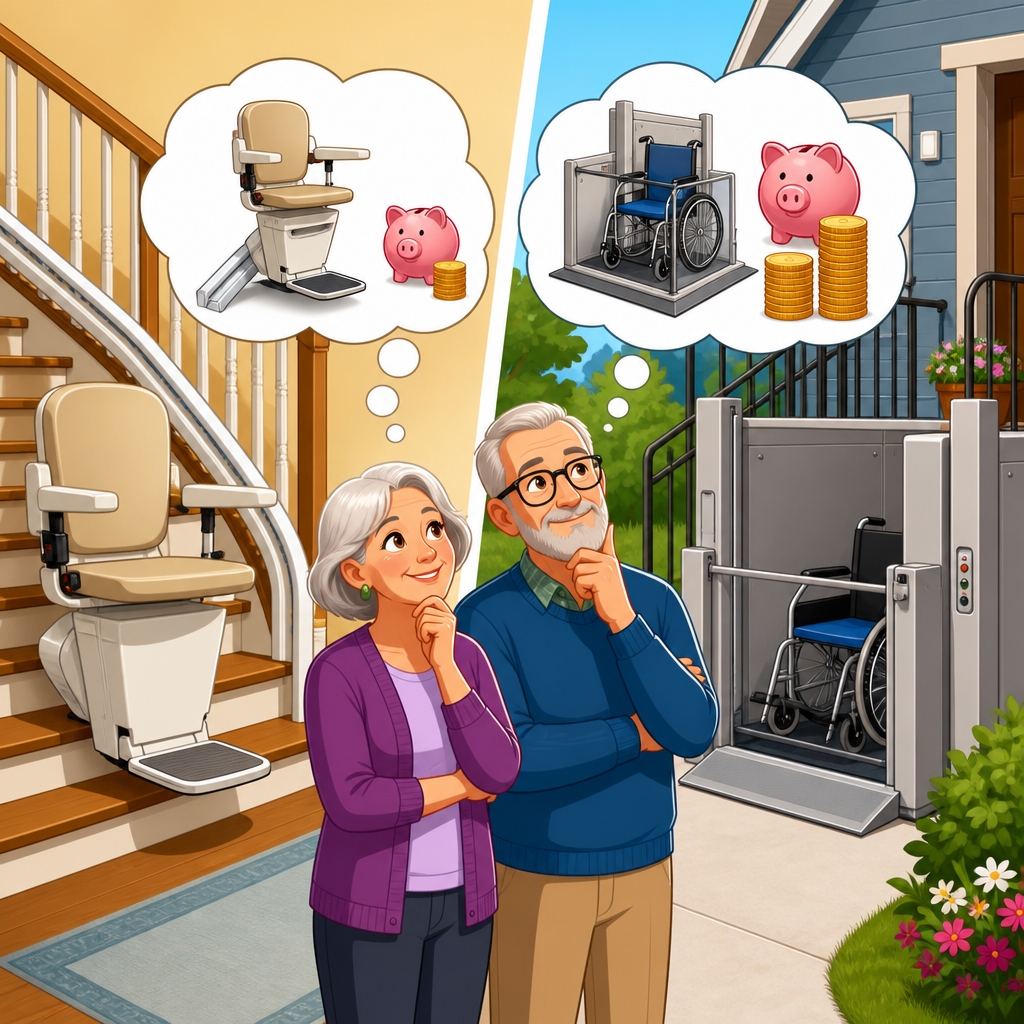
If your main question is “Which option is cheaper?” the answer is clear: stair lifts almost always cost less upfront. The more useful question is “Which option costs less for my needs?” A straight stair lift is usually the lowest-cost path for a person who can sit safely, transfer independently, and use a standard staircase. A vertical platform lift is usually the better value for a wheelchair user or for a household trying to avoid repeated upgrades as mobility changes.
| Cost factor | Stair lift | Vertical platform lift |
|---|---|---|
| Typical installed starting range | $2,500 to $6,000 for straight models; $10,000+ for curved | $15,000 to $35,000+ for many residential projects |
| Best fit | Users who can transfer to a seat | Wheelchair, scooter, or low-transfer users |
| Installation time | Often hours for straight runs | Often days, plus permit timeline |
| Home modifications | Usually limited | May require pad, gates, electrical, landings, enclosure |
| Maintenance profile | Lower overall, battery replacements common | Higher overall, more components and inspections |
| Long-term adaptability | Limited if wheelchair use increases | Higher for changing mobility needs |
There is one exception worth noting. When a home has a complex curved staircase, a custom chair lift may approach the lower end of VPL pricing. At that point, layout matters. If there is room for a platform lift at an entry or through a garage, the larger system may deliver better access for a similar total investment. This is why a site-specific comparison is essential.
Hidden costs, ownership costs, and financing questions buyers should ask
The advertised price is only part of chair lift cost. Ownership costs include battery replacement, periodic service, remote controls, wear items, and eventual removal or replacement. Most modern stair lifts use battery-powered drive systems charged from household current. Those batteries typically last several years, but replacement is not free. Annual maintenance may range from modest preventive service on a straight stair lift to more substantial costs for a VPL that has gates, sensors, drive components, and code-related safety checks.
Repairs vary by age and parts availability. A discontinued lift with a low purchase price can become expensive if service parts are hard to source. This is one reason dealer support matters. I generally tell homeowners to ask not only about warranty length but also about local technician coverage, expected response time, and whether the dealer stocks batteries, chargers, seat switches, and carriage components. A strong service network reduces downtime, which has real value when the lift is essential for daily living.
Financing questions also shape the decision. Some dealers offer installment plans, but interest rates vary. Medicare typically does not pay for stair lifts because they are considered home modifications rather than durable medical equipment in the usual coverage framework, although Medicare Advantage plan details can differ. Medicaid waiver programs in some states may help, especially when the lift prevents institutional care. Veterans may have access to grants through the VA, and state vocational rehabilitation or assistive technology programs sometimes provide funding. Local nonprofits, area agencies on aging, and condition-specific charities can also help. In some cases, a doctor’s prescription and a detailed letter of medical necessity strengthen funding applications, even when they do not guarantee approval.
Tax treatment can matter too. If a lift is installed for medical reasons, some expenses may qualify as medical deductions subject to current IRS rules and thresholds. Buyers should confirm this with a tax professional because deductibility depends on personal circumstances and whether the improvement increases property value. The key point is simple: the best chair lift cost strategy includes funding research before you sign a contract.
How to choose the right lift for value, safety, and future needs
The right choice comes down to transfer ability, staircase shape, wheelchair use, caregiver demands, and expected progression of mobility limitations. Choose a stair lift when the user can sit down and stand up safely, the staircase can accommodate the folded chair without creating a hazard, and the household wants the lowest upfront cost with minimal renovation. Choose a vertical platform lift when independent transfer is difficult, a wheelchair must stay with the user, or future decline makes a seated lift a short-term fix.
Start with an in-home assessment from a qualified dealer and compare at least three written quotes. Ask each company to separate equipment, installation, permit allowance, electrical work, and optional features. Confirm weight capacity, warranty terms, service coverage area, and expected maintenance intervals. If the home may be sold within a few years, discuss resale implications and removal cost. If the user’s condition may change, ask the hard question now: will this lift still work in three years?
For many homes, the answer to “How much do chair lifts cost?” is straightforward: less than vertical platform lifts upfront, but not always less over the life of the need. A straight stair lift is often the best bargain in home accessibility. A curved stair lift can become a premium purchase quickly. A vertical platform lift costs more, yet it can be the more economical choice when it prevents unsafe transfers, preserves wheelchair use, and avoids replacement. The smart path is to price the complete project, match the equipment to real daily use, and plan for service from the start. If you are building your budget for accessibility, use this page as your hub, then gather quotes, review funding options, and choose the lift that solves tomorrow’s problem as well as today’s.
Frequently Asked Questions
What is the typical cost difference between a stair lift and a vertical platform lift?
In most homes, a stair lift is the lower-cost option upfront, while a vertical platform lift usually requires a much larger initial investment. A straight stair lift is often the most affordable category because it runs on a simple rail attached to the staircase. Once you move into curved staircases, custom rails, multiple landings, outdoor use, or heavy-duty seating, the price rises significantly. Even so, many stair lift projects still cost less than a vertical platform lift because installation is less structurally intensive.
A vertical platform lift, sometimes called a porch lift or wheelchair lift, generally costs more because it is lifting both the user and a mobility device on a platform rather than moving a seated rider on a chair. That means more equipment, more power requirements, more safety systems, and often more site preparation. Depending on the travel height, indoor or outdoor location, gate configuration, permits, and code-related upgrades, the final price can increase quickly. For families comparing quotes, the key point is that the base unit price is only part of the picture. Installation, electrical work, concrete pads, enclosures, and inspection requirements can make a major difference in total project cost.
If the user can safely transfer to a seat and the staircase layout is workable, a stair lift often delivers the best value in the short term. If the person uses a wheelchair or scooter and needs to stay in that mobility device during travel, a vertical platform lift may be the more practical choice despite the higher price. The most accurate cost comparison always comes from evaluating the user’s mobility needs, the home’s layout, and any code or structural requirements that apply to the installation.
Why can the cheapest stair lift or platform lift quote become the most expensive choice later?
The lowest quote can be misleading because accessibility equipment is not a simple retail purchase. It is part product, part installation, part safety planning, and part long-term support. A low initial price may exclude important items such as electrical upgrades, permit fees, custom fabrication, structural reinforcement, weather protection for outdoor units, or warranty coverage beyond basic parts. When those items are added later, the “budget” option may end up costing more than a better-planned proposal.
Another reason cheap quotes create problems is fit and appropriateness. A stair lift that is inexpensive but too narrow for the staircase, uncomfortable for the user, or difficult to operate may not solve the household’s real access problem. The same applies to a vertical platform lift selected only on price without considering wheelchair dimensions, landing space, gate swing, travel height, or local code compliance. If the equipment does not properly match the home and the user, owners often face costly modifications, service calls, or replacement sooner than expected.
Long-term affordability also depends on reliability and service access. A low-cost unit from a company with limited local support can become expensive if repairs take weeks, replacement parts are hard to source, or maintenance is inconsistent. In contrast, a higher-quality system with professional installation, good warranty terms, and dependable service may cost more upfront but less over time. That is why experienced buyers compare the complete lifecycle cost: purchase price, installation complexity, maintenance, downtime risk, and how likely the equipment is to meet future mobility needs.
Which option offers better long-term value for changing mobility needs?
The answer depends on whether the user’s mobility is expected to remain stable or become more limited over time. A stair lift can be an excellent long-term value for someone who can sit safely, use arm and foot controls or call/send controls, and transfer on and off the chair with confidence. For many older adults, that makes a stair lift a practical and cost-effective way to stay in a multilevel home without major remodeling. It usually installs faster, costs less initially, and can extend safe access for years.
However, if the user already relies on a wheelchair or is likely to need one in the near future, a vertical platform lift may offer better long-term value even though it costs more at the beginning. It eliminates the need to transfer into a chair and allows travel while remaining in a wheelchair or scooter. That can reduce caregiver strain, improve independence, and avoid the cost of replacing a stair lift later if mobility declines. In real-world planning, this is one of the biggest reasons families choose the more expensive option: they are trying to avoid paying twice.
Long-term value also includes how the equipment affects the whole household. A stair lift may fold up when not in use, but it still occupies staircase space and may not work well for every user in a shared home. A vertical platform lift requires more room and more installation work, but it can be a more universally usable accessibility feature when mobility needs are complex. If families are comparing value rather than just sticker price, they should ask not only what works today, but what will still work safely and comfortably three to five years from now.
What installation and code factors most affect the total project cost?
For stair lifts, the main cost factors include whether the staircase is straight or curved, how many stops are needed, whether there are tight landings or obstructions, and whether a standard or heavy-duty model is required. A straight stair lift on an open, uncomplicated staircase is usually the simplest and least expensive installation. Curved stairs are different because the rail is custom-built to match the exact dimensions and turns of the staircase. That custom manufacturing is one of the biggest reasons costs increase.
Vertical platform lifts are typically more affected by site conditions and code requirements. The total project cost may include a concrete pad, dedicated electrical service, landing gates, interlocks, weatherproofing, drainage planning, and in some cases an enclosure or hoistway. Travel height matters too; a short rise from a garage into a home may be simpler than a lift serving a porch or deck with more elevation. Depending on the jurisdiction, permits and inspections can add both cost and time. Some areas have stricter requirements for residential accessibility equipment than homeowners expect, especially for outdoor installations.
This is why apples-to-apples comparison matters. One contractor may quote only the lift itself, while another includes all related work needed for a complete, compliant installation. Families should ask for a line-item proposal showing equipment, labor, electrical, site prep, permits, code-related features, and warranty terms. That level of detail makes it easier to understand the real price difference between a stair lift and a vertical platform lift and helps prevent surprises after work begins.
How should families decide whether a stair lift or vertical platform lift is the better financial choice?
The best financial choice is the one that safely meets the user’s needs without creating avoidable future costs. Start with the user, not the product. Can the person transfer independently or with assistance into a stair lift seat? Are balance, leg strength, and trunk stability good enough for safe use? If yes, a stair lift may provide excellent value, particularly if the staircase is straight and the goal is to control upfront spending. If no, a stair lift may seem cheaper initially but become a poor investment because it does not solve the actual mobility challenge.
Next, look closely at the home. Stair configuration, available landing space, doorway access, and wheelchair turning room all affect feasibility and cost. A platform lift may be the smarter investment if the user needs wheelchair access between levels and the home can accommodate the installation with reasonable site work. On the other hand, if structural modifications for a platform lift are extensive, some families explore whether a stair lift, a first-floor room conversion, or another accessibility strategy might offer better total value.
Finally, compare total ownership cost rather than purchase price alone. Ask about maintenance schedules, battery replacement, service response times, warranty coverage, expected lifespan, and resale or reusability options. Consider whether the equipment will still work if health needs change. In many cases, the right answer is not “Which one costs less?” but “Which one avoids the most expense, risk, and disruption over time?” That is the cost comparison that leads to better decisions and safer homes.